Sunday, March 8, 2015

In Pursuit of Spring  - the spring of 1913.


(Aries, Gemini and Taurus for the spring season.)


 Edward Thomas's bicycle journey from London to the Somerset coast, on which he based In Pursuit of Spring,( first published in 1914 by Thomas Nelson),  consists of idiosyncratic, personal responses to his journey.  
In Pursuit of Spring is the most important prose work of Thomas's, as it is nearer to the writing he wanted to do, shows a great deal of himself and was the work that Frost identified as showing that his friend could and should write poetry.
 
 
End-page of my original edition
 
 
Edward Thomas begins with a chapter about the preceding weeks, leading up to Good Friday 1913 on what was also, like ours now, a March Easter. He has a good deal to say about the weather and clearly it was much more variable than our March with its almost unremitting cold.
 
In many of his prose works he begins with a leaving of London. Thomas's relationship with London is complex. As a small boy he was drawn to the areas most resembling true country, especially Wandsworth Common.
The Long Pond.
Wandsworth Common, towards Bolingbroke Grove.
 
 It is those areas he regrets when they have been tidied up or built on - in one case made into a football pitch. He regrets the gypsies who would settle, set up a small fair on holidays (it begins on Good Friday) and perhaps stay on or move elsewhere.
 
But Thomas needed London for work and friendships. He visited editors, stayed with his parents, lunched with Eleanor and others, worked for Harold Monro's Poetry Bookshop as a reviewer and of course met Robert Frost there at one of his regular literary gatherings.
 
In the second chapter, passing through London suburbs towards Epsom,  I noticed references to  things that are gone - elms, quite prolific and important, often with rookeries. And hot-cross buns on Good Friday only. My daughter just remembers the baker delivering them to the small hamlet where we lived then - mid seventies - but we can't really remember when that changed.
 
The first day and first chapter travels from Wandsworth to Guildford.
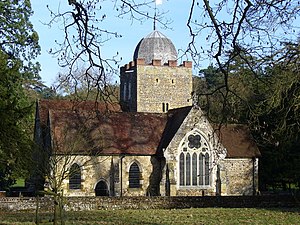
 
Saxon/Norman Aldbury 'neglected old church ....too much like a shameless unburied corpse.' Maybe he didn't like the 19th cupola that replaced a spire.
Now listed, restored , preserved and protected from all sides.
 
The Hog's Back near Guildford
 
Here is an extract from the novel: 

'Robert read out sections concerning the Other Man who reappeared time and again during Edward’s journey from London to the Quantocks. Certainly there was something uncanny, an uneasiness, about the contingency, re-occurring over and over, which might make a poem. Robert’s own poetry, his ‘books of people’, could have accommodated such a character. But had Robert seen further, seen what the Other Man was?

No, Robert was turning on. He read a passage where Edward had almost despaired of finding a bed for the night on Easter day.

‘Listen:  “I found a bed and a place to sit and eat in, and to listen to the rain breaking over gutters and splashing on to stones, and pipes swallowing rain to the best of their ability, and signboards creaking in the wind; and to reflect on the imperfections of  inns and life¾

You see?’

Edward smiled – weather was a prevailing theme for him, like a descant accompanying his life. He remembered the rest of the chapter – his long discourse on clay pipes and the Other Man’s obsession with weather vanes. Unlikely that Robert would find much in them. No, he moved on, commenting on the passage on George Herbert at Bemington.

When he came to the chapter on Somerset he fell silent. Edward could hear the water murmuring below them under the bridge again.

‘What are you reading?’ Edward asked after a time.

‘I guess it’s everywhere, the poetry – just listen.’ He read in his leisurely way, breaking the lines as though he were reading blank verse.

‘I went out into the village at about half-past nine in the dark, quiet evening. A few stars penetrated the soft sky; a few lights shone on earth, from a distant farm seen through a gap in the cottages. Single and in groups, separated by gardens and bits of orchard, the cottages were vaguely discernible; here and there a yellow window square gave out a feeling of home, tranquillity, security. Nearly all were silent. Ordinary speech was not to be heard, but from one house came the sounds of a harmonium being played and a voice singing a hymn, both faintly. A dog barked far off. After an interval a gate fell-to lightly. Nobody was on the road.”

‘And again – these images …see:  “The pollard willows fringing the green, which in the sunlight resemble mops, were now very much like a procession of men, strange primeval beings, pausing to meditate in the darkness.”

That’s great. The music and the drama in it, working together. And the way it ends:  “I felt that I could walk on thus, sipping the evening silence and solitude, endlessly.” '

Edward looked down from the footbridge into the dark brook; he was both excited and impatient. If Robert would just leave him alone for a while now, he thought. It was for him to evaluate his own work. If there was a possibility of him trying poetry, well, then it was for him to find his sources, his subjects.

‘Robert, I think I have to be getting back to work. But thank you. Next time we meet, though, let’s talk about your poetry.’ '

Tuesday, February 10, 2015

Edward Thomas' Beauty', another 'sprained ankle' poem.

This is my favourite Thomas poem. A miniature eighteen-line autobiography, an honest self-appraisal, a misery-memoir consciously and humorously undermined and upturned. A not-quite sonnet -currently fashionable - retaining the punch of the mood and tone change and letting it blossom. Those birds, always exact to their 'jizz'  but meaning much more:
'The birds may represent alternative ways of dealing with neurosis; a regressive resort to nostalgia, wailing for something lost; or progress towards the grounded selfhood phrased as 'home and love'.


                          W HAT does it mean? Tired, angry, and ill at ease,
No man, woman, or child alive could please
Me now. And yet I almost dare to laugh
Because I sit and frame an epitaph-
'Here lies all that no one loved of him
And that loved no one.' Then in a trice that whim
Has wearied. But, though I am like a river
At fall of evening when it seems that never
Has the sun lighted it or warmed it, while
Cross breezes cut the surface to a file,
This heart, some fraction of me, happily
Floats through a window even now to a tree
Down in the misting, dim-lit, quiet vale;
Not like a pewit that returns to wail
For something it has lost, but like a dove
That slants unswerving to its home and love.
There I find my rest, and through the dusk air
Flies what yet lives in me. Beauty is there

Wednesday, January 28, 2015

17th, 18th & 20th January1915- three significant poems.

The Unknown Bird, The Mill-Pond and Man and Dog.
All three have notebook entries as possible origins, and The Unknown Bird has a passage in The Happy-Go-Lucky Morgans, a sad passage where the bird is forlorn and seems to bring sorrow with it. Yet not so in this poem, more a transcendence,
                    'if sad
Twas only with joy too, too far off
For me to taste it. '

The note-takers /naturalists miss this transcendence - 'natural history [is in} danger of falling into the hands of mere takers of notes.'  He too was ambivalent about his own incessant note-book filling and in this poem - compared with Man and Dog- he has begun to find more of himself.

The Unknown Bird     
Three lovely notes he whistled, too soft to be heard
If others sang; but others never sang
In the great beech-wood all that May and June.
No one saw him: I alone could hear him
Though many listened. Was it but four years
Ago? or five? He never came again.
 
Oftenest when I heard him I was alone,
Nor could I ever make another hear.
La-la-la! he called, seeming far-off—
As if a cock crowed past the edge of the world,
As if the bird or I were in a dream.
Yet that he travelled through the trees and sometimes
Neared me, was plain, though somehow distant still
He sounded. All the proof is—I told men
What I had heard.
 
                                   I never knew a voice,
Man, beast, or bird, better than this. I told
The naturalists; but neither had they heard
Anything like the notes that did so haunt me,
I had them clear by heart and have them still.
Four years, or five, have made no difference. Then
As now that La-la-la! was bodiless sweet:
Sad more than joyful it was, if I must say
That it was one or other, but if sad
'Twas sad only with joy too, too far off
For me to taste it. But I cannot tell
If truly never anything but fair
The days were when he sang, as now they seem.
This surely I know, that I who listened then,
Happy sometimes, sometimes suffering
A heavy body and a heavy heart,
Now straightway, if I think of it, become
Light as that bird wandering beyond my shore.


The Mill-Pond
 
 
The sun blazed while the thunder yet
Added a boom:
A wagtail flickered bright over
The mill-pond’s gloom:

Less than the cooing in the alder
Isles of the pool
Sounded the thunder through that plunge
Of waters cool.

Scared starlings on the aspen tip
Past the black mill.
Outchattered the stream and the next roar
Far on the hill.

As my feet dangling teased the foam
That slid below
A girl came out. ‘Take care!’ she said—-
Ages ago.

She startled me, standing quite close
Dressed all in white:
Ages ago I was angry till
She passed from sight.

Then the storm burst, and as I crouched
To shelter, how
Beautiful and kind, too, she seemed,
As she does now!

Edna Longley's thoughts on this are so interesting but hard to summarise: querying why the poem seems to fade and maybe sentimentalise rather than build to power, she describes it as neither a war or a love poem and speculates on why that be. She contrasts it with the waters in A Dream.

Man and Dog
A very easy-to-love poem, straight from his prose and giving a social history through an individual. It reminds me of Frost's hired worker in Death of The Hired Man but still more of a character in Wordsworth.
''Twill take some getting.' 'Sir, I think 'twill so.'
The old man stared up at the mistletoe
That hung too high in the poplar's crest for plunder
Of any climber, though not for kissing under:
Then he went on against the north-east wind--- Straight but lame, leaning on a staff new-skinned, Carrying a brolly, flag-basket, and old coat,---
Towards Alto, ten miles off. And he had not
Done less from Chilgrove where he pulled up docks. 'Twere best, if he had had 'a money-box',
To have waited there till the sheep cleared a field
For what a half-week's flint-picking would yield.
His mind was running on the work he had done
Since he left Christchurch in the New Forest, one
Spring in the 'seventies,---navvying on dock and line From Southampton to Newcastle-on-Tyne,---
In 'seventy-four a year of soldiering
With the Berkshires,---hoeing and harvesting
In half the shires where corn and couch will grow.
His sons, three sons, were fighting, but the hoe
And reap-hook he liked, or anything to do with trees.
He fell once from a poplar tall as these:
The Flying Man they called him in hospital.
'If I flew now, to another world I'd fall.'
He laughed and whistled to the small brown bitch
With spots of blue that hunted in the ditch.
Her foxy Welsh grandfather must have paired
Beneath him. He kept sheep in Wales and scared Strangers, I will warrant, with his pearl eye
And trick of shrinking off as he were shy,
Then following close in silence for---for what?
'No rabbit, never fear, she ever got,
Yet always hunts. To-day she nearly had one:
She would and she wouldn't. 'Twas like that.
The bad one!
She's not much use, but still she's company,
Though I'm not. She goes everywhere with me. So
Alton I must reach to-night somehow:
I'll get no shakedown with that bedfellow
From farmers. Many a man sleeps worse to-night
Than I shall.' 'In the trenches.' 'Yes, that's right.
But they'll be out of that---I hope they be---
This weather, marching after the enemy.'
'And so I hope. Good luck.' And there I nodded
'Good-night. You keep straight on,' Stiffly he plodded; And at his heels the crisp leaves scurried fast,
And the leaf-coloured robin watched. They passed,
The robin till next day, the man for good,
Together in the twilight of the wood.                             

Saturday, January 24, 2015

January 1915 'sprained ankle poems -
Edward Thomas wrote prolifically when confined to the house because of a serious ankle injury.
15th January - The Cuckoo,  and Swedes


The Cuckoo is the only Thomas poem with a woman narrator. It surely stemmed from a real conversation with a shepherd's widow. A passage in The Heart of England refers to the same shepherd's call. The last word is strengthened for me by the 'my' that precedes it.
The Cuckoo
That's the cuckoo, you say. I cannot hear it.
When last I heard it I cannot recall; but I know
Too well the year when first I failed to hear it -
It was drowned by my man groaning out to his sheep 'Ho! Ho!'

Ten times with an angry voice he shouted
'Ho! Ho!' but not in anger, for that was his way.
He died that Summer, and that is how I remember
The cuckoo calling, the children listening, and me saying 'Nay'.

And now, as you said, 'There it is', I was hearing
Not the cuckoo at all, but my man's 'Ho! Ho!' instead.
And I think that even if I could lose my deafness
The cuckoo's note would be drowned by the voice of my dead.

Swedes       

 They have taken the gable from the roof of clay
On the long swede pile.  They have let in the sun
To the white and gold and purple of curled fronds
Unsunned.  It is a sight more tender-gorgeous
At the wood-corner where Winter moans and drips
Than when, in the Valley of the Tombs of Kings,
A boy crawls down into a Pharaoh's tomb
And, first of Christian men, beholds the mummy,
God and monkey, chariot and throne and vase,
Blue pottery, alabaster, and gold.

But dreamless long-dead Amen-hotep lies.
This is a dream of Winter, sweet as Spring.

This is a popular poem that takes the every-day and sees in it something  remarkable. I have always noticed colour in Thomas's poems and prose, the many greens especially, but this is certainly more 'tender-gorgeous.' Of course Harold Carter had yet to open the tomb of Tutankhamen  that created such a sensation in the twenties.


Tuesday, January 20, 2015

Edward Thomas's 'sprained ankle' poems - Over the Hills and The Lofty Sky.The titles say it all, don't they. I feel I haven't taken seriously enough just what an ordeal it must have been for Thomas being confined to the house. I myself need to get out of doors a great deal, but for him it was sometimes life-saving.
These two poems are again about remembering. The first concerns remembering remembering, but he encounters some problem, some flaw in the memory or in himself, implying that it is impossible to go back - in reality or just in full memory I don't know. Longley recommends we look carefullt at the line-breaks.                             

The Lofty Sky has a vibrant rhythm and energy - pent-up energy. Edna Longley sees it as having a strong Romantic theme.

To-day I want the sky,
The tops of the high hills,
Above the last man's house,
His hedges, and his cows,
Where, if I will, I look
Down even on sheep and rook,
And of all things that move
See buzzards only above:-
Past all trees, past furze
And thorn, where nought deters
The desire of the eye
For sky, nothing but sky.
I sicken of the woods
And all the multitudes
Of hedge-trees. They are no more
Than weeds upon this floor
Of the river of air
Leagues deep, leagues wide, where
I am like a fish that lives
In weeds and mud and gives
What's above him no thought.
I might be a tench for aught
That I can do to-day
Down on the wealden clay.
Even the tench has days
When he floats up and plays
Among the lily leaves
And sees the sky, or grieves
Not if he nothing sees:
While I, I know that trees
Under that lofty sky
Are weeds, fields mud, and I
Would arise and go far
To where the lilies are.Edward Thomas's 'sprained ankle' poems - Over the Hills and The Lofty Sky.
The titles say it all, don't they. I feel I haven't taken seriously enough just what an ordeal it must have been for Thomas being confined to the house. I myself need to get out of doors a great deal, but for him it was sometimes life-saving.
These two poems are again about remembering. The first concerns remembering remembering, but he encounters some problem, some flaw in the memory or in himself, implying that it is impossible to go back - in reality or just in full memory I don't know. Longley recommends we look carefullt at the line-breaks.                             

The Lofty Sky has a vibrant rhythm and energy - pent-up energy. Edna Longley sees it as having a strong Romantic theme.

To-day I want the sky,
The tops of the high hills,
Above the last man's house,
His hedges, and his cows,
Where, if I will, I look
Down even on sheep and rook,
And of all things that move
See buzzards only above:-
Past all trees, past furze
And thorn, where nought deters
The desire of the eye
For sky, nothing but sky.
I sicken of the woods
And all the multitudes
Of hedge-trees. They are no more
Than weeds upon this floor
Of the river of air
Leagues deep, leagues wide, where
I am like a fish that lives
In weeds and mud and gives
What's above him no thought.
I might be a tench for aught
That I can do to-day
Down on the wealden clay.
Even the tench has days
When he floats up and plays
Among the lily leaves
And sees the sky, or grieves
Not if he nothing sees:
While I, I know that trees
Under that lofty sky
Are weeds, fields mud, and I
Would arise and go far
To where the lilies are.Edward Thomas's 'sprained ankle' poems - Over the Hills and The Lofty Sky.
The titles say it all, don't they. I feel I haven't taken seriously enough just what an ordeal it must have been for Thomas being confined to the house. I myself need to get out of doors a great deal, but for him it was sometimes life-saving.
These two poems are again about remembering. The first concerns remembering remembering, but he encounters some problem, some flaw in the memory or in himself, implying that it is impossible to go back - in reality or just in full memory I don't know. Longley recommends we look carefullt at the line-breaks.                             

The Lofty Sky has a vibrant rhythm and energy - pent-up energy. Edna Longley sees it as having a strong Romantic theme.

To-day I want the sky,
The tops of the high hills,
Above the last man's house,
His hedges, and his cows,
Where, if I will, I look
Down even on sheep and rook,
And of all things that move
See buzzards only above:-
Past all trees, past furze
And thorn, where nought deters
The desire of the eye
For sky, nothing but sky.
I sicken of the woods
And all the multitudes
Of hedge-trees. They are no more
Than weeds upon this floor
Of the river of air
Leagues deep, leagues wide, where
I am like a fish that lives
In weeds and mud and gives
What's above him no thought.
I might be a tench for aught
That I can do to-day
Down on the wealden clay.
Even the tench has days
When he floats up and plays
Among the lily leaves
And sees the sky, or grieves
Not if he nothing sees:
While I, I know that trees
Under that lofty sky
Are weeds, fields mud, and I
Would arise and go far
To where the lilies are.Edward Thomas's 'sprained ankle' poems - Over the Hills and The Lofty Sky.
The titles say it all, don't they. I feel I haven't taken seriously enough just what an ordeal it must have been for Thomas being confined to the house. I myself need to get out of doors a great deal, but for him it was sometimes life-saving.
These two poems are again about remembering. The first concerns remembering remembering, but he encounters some problem, some flaw in the memory or in himself, implying that it is impossible to go back - in reality or just in full memory I don't know. Longley recommends we look carefullt at the line-breaks.                             

The Lofty Sky has a vibrant rhythm and energy - pent-up energy. Edna Longley sees it as having a strong Romantic theme.

To-day I want the sky,
The tops of the high hills,
Above the last man's house,
His hedges, and his cows,
Where, if I will, I look
Down even on sheep and rook,
And of all things that move
See buzzards only above:-
Past all trees, past furze
And thorn, where nought deters
The desire of the eye
For sky, nothing but sky.
I sicken of the woods
And all the multitudes
Of hedge-trees. They are no more
Than weeds upon this floor
Of the river of air
Leagues deep, leagues wide, where
I am like a fish that lives
In weeds and mud and gives
What's above him no thought.
I might be a tench for aught
That I can do to-day
Down on the wealden clay.
Even the tench has days
When he floats up and plays
Among the lily leaves
And sees the sky, or grieves
Not if he nothing sees:
While I, I know that trees
Under that lofty sky
Are weeds, fields mud, and I
Would arise and go far
To where the lilies are.

Thursday, January 15, 2015

'Adlestrop' and 'Tears' - more 'sprained ankle' poems.

Both written or at least begun on the 8th January!

We may think there is nothing new to say about Adlestrop, but Edna Longley's marvellous notes to her edition sees the intense juxtaposition of composition showing a development. Tears has history and ambiguity, reflecting the violence of hounds and soldiers as well as their beauty, and perhaps stirrings of conscience about the enlisting issue.

Adlestrop  - and perhaps that's why it's so easy to love - is an appreciation of England 'aesthetically' only, something about which, after the epiphany of the autumn before, Thomas was beginning to feel uncomfortable.

But how wonderful that he could use his memories and his field notebooks to create these works while sitting in a deck-chair in the living room with his leg propped up, taking up most of the room and no doubt grumbling at everything Helen was doing.
 
Tears
It seems I have no tears left.
They should have fallen---
Their ghosts, if tears have ghosts, did fall---that day
When twenty hounds streamed by me, not yet combed out
But still all equals in their rage of gladness
Upon the scent, made one, like a great dragon
In Blooming Meadow that bends towards the sun
And once bore hops: and on that other day
When I stepped out from the double-shadowed
Tower Into an April morning, stirring and sweet
And warm. Strange solitude was there and silence.
A mightier charm than any in the Tower
Possessed the courtyard. They were changing guard,
Soldiers in line, young English countrymen,
Fair-haired and ruddy, in white tunics.
Drums And fifes were playing 'The British Grenadiers'.
The men, the music piercing that solitude
And silence, told me truths I had not dreamed,
And have forgotten since their beauty passed.


Wednesday, January 14, 2015

Edward Thomas - the sprained ankle poems.

Laid low with a badly sprained ankle, Edward Thomas was writing poems at a great rate. He once said he wrote well when in pain.
A Private, written on 6th and 7th January, has the first reference, I think, to the war, and it seems he altered it from its first draft, which referred to 'an old man' and implied the Boer war. What a powerful message it gives about those thousands lost and never found, or unrecognizable.
 
Pictures by Nick Hedges
      
This ploughman dead in battle slept out of doors
Many a frosty night, and merrily
Answered staid drinkers, good bedmen, and all bores:
'At Mrs Greenland's Hawthorn Bush,' said he,
'I slept.' None knew which bush. Above the town,
Beyond 'The Drover', a hundred spot the down
In Wiltshire. And where now at last he sleeps
More sound in France—that, too, he secret keeps.
 
 
Snow

Snow
As Edna Longley comments, this is a traditional folk idea but the oxymorons of 'gloom of whiteness' and 'dusky brightness' darken the metaphor.
In the gloom of whiteness,
In the great silence of snow,
A child was sighing
And bitterly saying: "Oh,
They have killed a white bird up there on her nest,
The down is fluttering from her breast!"
And still it fell through that dusky brightness
On the child crying for the bird of the snow.