Tuesday, April 22, 2014

In Pursuit of Spring,  - in Surrey.


I heard a cuckoo today. What a different spring this year than last. I remember the day I took these Surrey photos - it was freezing!


By one of those strange coincidences I had to visit on Wednesday the area of Thomas's first, London to Guildford, stretch - somewhere I've never been before. (It was a 'buyer collects' ebay purchase.)

We didn't have much time, but were able to visit first SHALFORD
The Common


'Crossing the little railway from the mills, I came
in sight of the Hog's Back, by which I must go
to Farnham. That even, straight ridge pointing
westward, and commanding the country far away
on either side, must have had a road along it since
man went upright, and must continue to have one
so long as it is a pleasure to move and to use the
eyes together. It is a road fit for the herald Mer-
cury and the other gods, because it is as much in
heaven as on earth. The road I was on, creeping
humbly and crookedly to avoid both the steepness
of the hills and the wetness of the valley, was by
comparison a mole run. Between me and the
Hog's Back flowed the Wey, and as the Tilling-
bourne approached it the valley spread out and
flattened into Shalford's long, wet common. My
road crossed the common, a rest for gypsies and
their ponies. Shalford village also is on the flat,
chiefly on the right hand side of the road, nearer
the hill, and away from the river, so that its out-
look over the levels gives it a resemblance to a
seaside village. Instead of the sea it had formerly
a fair ground of a hundred and forty acres. Its inn
is the " Queen Victoria " charmless name. ' IPS. (Still there)
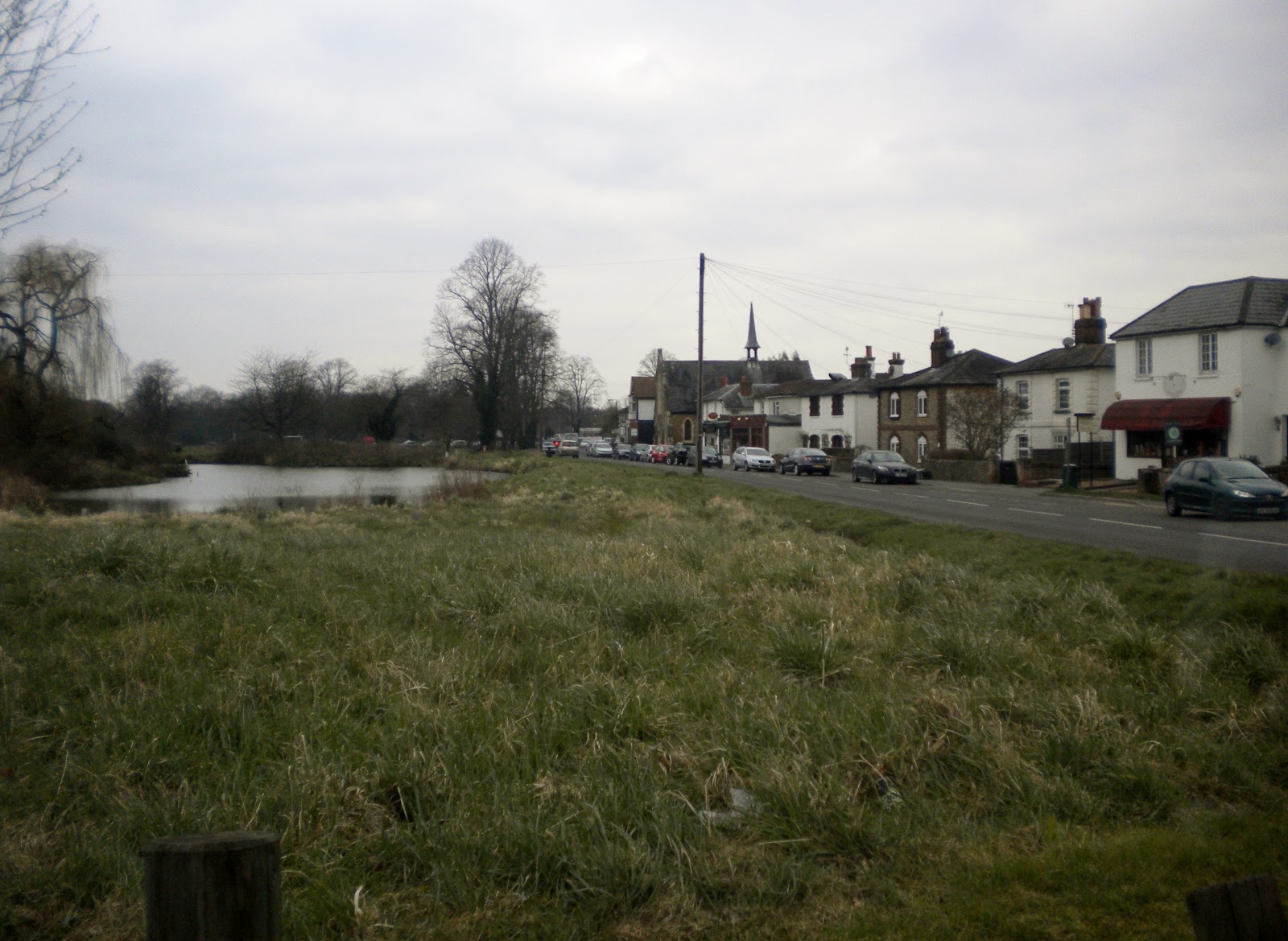

Cold grey day in Shalford.


The North Downs


The North Downs , or the Surrey Hills, are more wooded and attractive than I would have imagined. Proportional to its size, Surrey is the most wooded county in England.
 
'The Downs were beginning to
give me some shelter, and I went on under them,
glad of the easier riding. The Tillingbourne here
was running closer under the Downs, and the river
level met the hillside more sharply than before.
The road bent above the meadows and showed them
flat to the very foot of a steep, brown slope covered
with beeches. The sky lightened lightened too
much : St. Martha's tower, almost reaching up into
the hurrying white rack, was dark on its dark hill.
So I came to Albury, which has the streamlet be-
tween it and the Downs, unlike Abinger Hammer,
Gomshall, and Shere. The ground, used for vege-
tables and plum trees, fell steeply down to the
water, beyond which it rose again as steeply in a
narrow field bounded horizontally by a yet steeper
strip of hazel coppice ; beyond this again the rise
was continued in a broader field extending to the
edge of the main hillside beech wood. Albury is
one of those villages possessing a neglected old
church and a brand-new one. In this case the
new is a decent enough one of alternating flint
and stone, built among trees on a gradual rise.
But the old one is too much like a shameless un-
buried corpse.

Twice I crossed the Tillingbourne, and came to
where it broadened into a pond. This water on
either side of the road was bordered by plumed
sedges and clubbed bulrushes. At the far side,
under the wooded Downside crowned by St. Martha's,
was a pale, shelterless mill of a ghostly bareness.
The aspens were breaking into yellow-green leaves
round about, especially one prone aspen on the left
where a drain was belching furious, tawny water into
the stream, and shaking the spears of the bulrushes.

As I went on towards Chilworth, gorse was blos-
soming on the banks of the road. Behind the
blossom rose up the masses of hillside wood, now
scarcely interrupted save by a few interspaces of
lawn-like grass.' IPS.
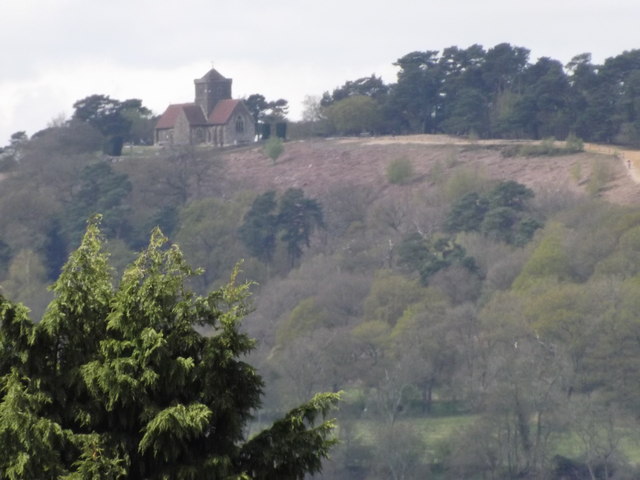
 
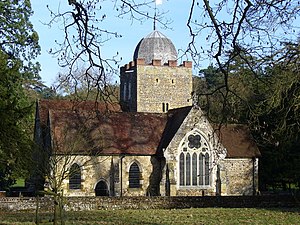
 www.geograph.com   St Martha's Church, Albury.
 
Albury sits in the south side at the foot  of the Downs. I liked this farm and the fisheries on the Albury Estate.:


But it was so bitterly cold that it was a pleasure to drive up the Downs to Newlands Corner and its Visitors' Centre.
 
And to take some more chilly-looking pictures:


'At first, [the Downs}
  were thoroughly tamed,
their smoothness made park-like, their trees mostly
fir. Beyond, their sides, of an almost uniform
gentle steepness, but advancing and receding,
hollowed and cleft, were adorned by unceasingly
various combinations of beech wood, of scattered
yew and thorn, of bare ploughland or young corn,
and of naked chalk.' IPS.
 
The warden told us that the weather was having a deleterious effect on the wildlife - migrating birds not arriving, 'not knowing where they are.'  We are complaining about the weather - inconvenient for us - but serious for the mammals and birds. An article in the Observer comments:
 
"Britain's continued freezing weather is threatening ever greater numbers of wild animals, birds and insects across the country, experts have warned. The current cold spell – one of the longest on record – is particularly affecting creatures that are already struggling to survive the loss of their habitats and changes in climate.
Examples include the hedgehog, which has already suffered a devastating loss of numbers over the past three decades and is now badly affected by the cold weather. In addition, threatened reptiles such as the grass snake and slowworm require sunny, warm conditions when they emerge from hibernation. Such a prospect is still remote, say meteorologists.
... 
For hedgehogs, the prolonged cold weather has had a particularly severe impact. "Many animals that went into hibernation in November or December last year are still sleeping," said Fay Vass, chief executive of the Hedgehog Preservation Society. "The weather is not yet warm enough to wake them. Usually they would be up and about by now."
The problem was that the longer a hedgehog remained asleep, the weaker it got and the less energy an animal had to restore itself to wakefulness, added Vass. "It depends just how healthy and well-fed an animal was when it went into hibernation. But in general, the longer the cold weather lasts, the greater the number of animals that will not wake up at all."
 
Experts stress that the public can help. The RSPB has urged householders to keep bird feeders regularly topped up with high-energy, high-fat food and to keep water dishes filled. Similarly, the Hedgehog Preservation Society recommends leaving plentiful water supplies and also food, either meaty cat or dog meals or specialist hedgehog food."

Another article specifically mentions the chiff-chaff's lateness this year.

The drive from here into London, our destination, probably traced some of Thomas's route - near Epsom, and in through Wandsworth, but apart from the ever-flowering gorse, not really recognisable.

Poems:  Shelley: Winter

It was a winter such as when birds die
In the deep forests; and the fishes lie
Stiffened in the translucent ice, which makes
Even the mud and slime of the warm lakes
A wrinkled clod as hard as brick; and when,
Among their children, comfortable men
Gather about great fires, and yet feel cold:
Alas, then, for the homeless beggar old!      


Another bird poem, in which Edward Thomas positively relishes winter.

Bird's Nests

The summer nests uncovered by autumn wind,
Some torn, others dislodged, all dark,
Everyone sees them: low or high in tree,
Or hedge, or single bush, they hang like a mark.

Since there's no need of eyes to see them with
I cannot help a little shame
That I missed most, even at eye's level, till
The leaves blew off and made the seeing no game.

'Tis a light pang. I like to see the nests
Still in their places, now first known,
At home and by far roads. Boys knew them not,
Whatever jays and squirrels may have done.

And most I like the winter nests deep-hid
That leaves and berries fell into:
Once a dormouse dined there on hazel-nuts,
And grass and goose-grass seeds found soil and grew.
                                                                 * * *
 
 Publishing Matters - a surprise sent on to me by Frank Egerton today, 6th April.

'Guardian Books, 5th April 2013:Reader reviews roundup

A biographical novel about the poet Edward Thomas 

Edward Thomas
Bardly behaved? … Edward Thomas. Photograph: EO Hoppe/Corbis
 
Hello and welcome back to our reader reviews roundup, which returns after a two-week easter break. Though the books desk might have been slacking, our reader reviewers have not.

One of the liveliest conversations has been inspired by a novel about the poet Edward Thomas. It was published in February by the Oxfordshire-based "micro-publisher" Streetbooks, whose founder Frank Egerton says: "My interest is in artisan publishing: which involves high quality, regional fiction, marketed locally in person and globally via the Internet. An analogy I like is that of the micro-brewery: a combination of tradition, passion and the opportunities offered by new technology."
A Conscious Englishman is by former teacher and probation officer Margaret Keeping, and either she has some very conscientious literary friends or her publisher's micro-brewery policy is producing some pretty heady results in the Edward Thomas fan club.
First to review it was ISWilton, who wrote:
What I love most about this book is the voice of his wife Helen. Much of the book is told from her viewpoint and we understand the pain of being married to a struggling, and sometimes, difficult artist.
Next came Georgeed, who felt Keeping conveyed Thomas's love of the English countryside particularly well.
evmason wrote the clincher over Easter weekend:
Her gift is to create in prose the landscapes and moods which Thomas captured in his poems. In showing us the genesis of 'The Manor Farm', 'Old Man', 'In Memoriam (Easter 1915)', she sends us straight back to the poetry, and for a writer who loves Thomas's work, what finer service could she render?
Definitely worth checking out then.' 

                             ---------------------------------------------------------------------------
 I'm glad to say that people I do know personally have all, without exception, also said how much they enjoyed it. Some knew a great deal about Edward Thomas, others very little.

This is the full evmason review:
Timely, Shapely.
2014 sees the 100th anniversary of the First World War; attention will be paid to the writers who remind us. Already the London stage has hosted a play about Edward Thomas, and this Easter the BBC begins readings from his book 'The Pursuit of Spring'. Margaret Keeping's 'A Conscious Englishman' is timely.
Her research is impeccable and she is scrupulous in indicating when she is quoting directly from letters, diaries, poems; where she must imagine, she convinces. Biography can be shapeless, but here the problem is solved by structuring the book around Thomas's search for an answer to the tormenting question - how should he respond to war? This sharp focus excises undigested lumps of research, much to this reader's pleasure. (It could be argued that the relationship with Edna Clarke-Hall is a diversion, but you have only to track her photograph on the internet to understand her allure.)
Helen Thomas has written devotedly of her marriage, and although to a later generation it may lack attraction, Margaret Keeping is wise and generous enough to understand that where both parties have needs which are being met, third-party censoriousness is inappropriate. Her Helen is allowed to speak, and her voice is an engaging one.
Above all, Thomas is a poet of those spots of time - in Margaret Keeping's words, those "moment[s] out of time that could contain something everlasting, a rapturous moment, always remembered." Her gift is to create in prose the landscapes and moods which Thomas captured in his poems. In showing us the genesis of 'The Manor Farm', 'Old Man', 'In Memoriam (Easter 1915)', she sends us straight back to the poetry, and for a writer who loves Thomas's work, what finer service could she render?
-------------------------------------------------------------------

Another surprise review on Amazon - I hadn't been checking:

A good read, 24 Mar 2013

This review is from: A Conscious Englishman (Paperback)
'This excellent book about the important but often overlooked Anglo-Welsh poet Edward Thomas, can be delightful. We experience the blossom of spring, the smell of apples and perry pears, him pushing his children on the swing in the orchard above the wide Gloucestershire fields. And there are some touching, not to mention passionate, moments with his wife Helen.
Margaret Keeping writes very skilfully, achieving some most economical character studies - 'Edward complained I treated everyone as if they were my children and they did not like that. It was nonsense, I was interested in people and hoped they would like me.' One can just see this bustling, fussing albeit well-meaning person driving everyone mad. But one can also see what an anchor she was to Thomas.
The book is an account of their relationship and the relationship with other literary greats of the day, particularly Robert Frost. It is also, of course, the story of Thomas's heart searching and indecision as he clambered to brief fame as a poet, and as such it deftly portrays selfishness, depression and anger.
Most of the narrative is in the third person, but some sections are given to Helen, which is effective in contrasting the down to earth practical point of view of a mother with that of an artist prepared to give up so much for his art. It points up both aspects and increases the feeling of reality in the story.
I would recommend this book to anyone who is interested in poetry, particularly turn of the century poets, English/Welsh rural life, or just a good read. '

      -------------------------------------------------------------------------------------------------------


Friday, April 11, 2014

In Pursuit of  Spring, 2.


Chapter III    Guildford to Dunbridge, and a riff on clay pipes.


On the Hog's Back he sees gypsies:

'I liked the look of the gypsies camping... If they were not there in fact, they would have to be invented. They are at home there. See them at nightfall, with their caravans drawn up facing the wind, and the men by the half-door at the back smoking, while the hobbled horses are grazing and the children playing near.'

(I owned a 'vardo' like this for some years but moved to a terraced house so it went to a good home.)
On to Farnham for breakfast, and to see:
'A small inn labelled "Cobbett's Birthplace" in letters as big as are usually given to the name of a brewer.'.
No longer:
'The Jolly Farmer burnt down completely in the 1980's - with the post box outside all that remained. We celebrate its resilience by hanging it from one of our rebuilt walls! '.   Hhhhmn.

He travelled on westward to Willey Mill on the Wey, the Surrey/Hampshire border.


cc Wordpress
Continuing on the Pilgrims' Way near Guildford
He had ridden  into Hampshire  where hops were grown then:'Many were the buildings related to hops, whose mellow brick work seemed to have been stained by a hundred harvests.'
In a remarkable passage Thomas describes a hunt, emphasising the scarlet riders and ending:
'Backwards and forwards galloped the riders before the right crossing of the railway was taken. The fox died in obscurity two miles away.'    I read restrained dislike,into that 'Backwards and forwards...'

After this the chapter diverts from topology into riffs on:

 local surnames,
  a tale of two sisters , Martha and Mary, with the characteristics implied by those names,

and then into clay pipes. Edward Thomas always carried his 'clay' a simple workman's pipe, and he riffs at great length on their different shapes, thickness, thinness and suitability.


found in our roof.

 
 Surely he is laughing at himself  in his pages of discourse on these pipes, good and bad. He follows them with bemusement at the Other Man's obsession with weather vanes and 'stupor' from having to listen to Thomas.
He describes the perfect pipe:

'This perfect clay pipe came from a shop at Oxford. Everywhere else I have looked in vain for them. I have never seen any one else smoking them who had not got them from me.
Tastes differ, but in this matter I cannot believe that anyone capable of distinguishing one clay from another would deny this one's excellence.
The Other Man cared nothing for the matter. He awoke from the stupor to which he had been reduced by listening, and asked,-
"Did you see that weather-vane at Albury in the shape of a pheasant? or the fox-shape one by the ford at Butts green? ......'


The Oxford tobacconist on the High Street still exists:


Poem - Digging, the first poem written after Edward Thomas enlisted. He sweeps through aeons of time.

Digging


What matter makes my spade for tears or mirth,
Letting down two clay pipes into the earth?
The one I smoked, the other a soldier
Of Blenheim, Ramillies, and Malplaquet
Perhaps. The dead man's immortality
Lies represented lightly with my own,
A yard or two nearer the living air
Than bones of ancients who, amazed to see
Almighty God erect the mastodon,
Once laughed, or wept, in this same  light of day.
                                                            
-----------------------------------------------------------------------------------------------------------


     A marvellous review on the Guardian web-site.
Timely, Shapely.
2014 sees the 100th anniversary of the First World War; attention will be paid to the writers who remind us. Already the London stage has hosted a play about Edward Thomas, and this Easter the BBC begins readings from his book 'The Pursuit of Spring'. Margaret Keeping's 'A Conscious Englishman' is timely.
Her research is impeccable and she is scrupulous in indicating when she is quoting directly from letters, diaries, poems; where she must imagine, she convinces. Biography can be shapeless, but here the problem is solved by structuring the book around Thomas's search for an answer to the tormenting question - how should he respond to war? This sharp focus excises undigested lumps of research, much to this reader's pleasure. (It could be argued that the relationship with Edna Clarke-Hall is a diversion, but you have only to track her photograph on the internet to understand her allure.)
Helen Thomas has written devotedly of her marriage, and although to a later generation it may lack attraction, Margaret Keeping is wise and generous enough to understand that where both parties have needs which are being met, third-party censoriousness is inappropriate. Her Helen is allowed to speak, and her voice is an engaging one.
Above all, Thomas is a poet of those spots of time - in Margaret Keeping's words, those "moment[s] out of time that could contain something everlasting, a rapturous moment, always remembered." Her gift is to create in prose the landscapes and moods which Thomas captured in his poems. In showing us the genesis of 'The Manor Farm', 'Old Man', 'In Memoriam (Easter 1915)', she sends us straight back to the poetry, and for a writer who loves Thomas's work, what finer service could she render?
 

                                 -------------------------------------------------------------------

Another surprise review on Amazon - I hadn't been checking:

A good read,

This review is from: A Conscious Englishman (Paperback)
This excellent book about the important but often overlooked Anglo-Welsh poet Edward Thomas, can be delightful. We experience the blossom of spring, the smell of apples and perry pears, him pushing his children on the swing in the orchard above the wide Gloucestershire fields. And there are some touching, not to mention passionate, moments with his wife Helen.
Margaret Keeping writes very skilfully, achieving some most economical character studies - 'Edward complained I treated everyone as if they were my children and they did not like that. It was nonsense, I was interested in people and hoped they would like me.' One can just see this bustling, fussing albeit well-meaning person driving everyone mad. But one can also see what an anchor she was to Thomas.
The book is an account of their relationship and the relationship with other literary greats of the day, particularly Robert Frost. It is also, of course, the story of Thomas's heart searching and indecision as he clambered to brief fame as a poet, and as such it deftly portrays selfishness, depression and anger.
Most of the narrative is in the third person, but some sections are given to Helen, which is effective in contrasting the down to earth practical point of view of a mother with that of an artist prepared to give up so much for his art. It points up both aspects and increases the feeling of reality in the story.
I would recommend this book to anyone who is interested in poetry, particularly turn of the century poets, English/Welsh rural life, or just a good read.

Thursday, March 27, 2014

In Pursuit of Spring


(Aries, Gemini and Taurus for the spring season.)

The new Little Toller edition with photographs renews interest in 'In Pursuit Of Spring.'

 Edward Thomas's bicycle journey from London to the Somerset coast, on which he based In Pursuit of Spring,( first published in 1914 by Thomas Nelson),  cosoists of idiosyncratic, personal responses to his journey.  
In Pursuit of Spring is the most important prose work of Thomas's, as it is nearer to the writing he wanted to do, shows a great deal of himself and was the work that Frost identified as showing that his friend could and should write poetry.
 
 
End-page of my original edition
 
 
Edward Thomas begins with a chapter about the preceding weeks, leading up to Good Friday 1913 on what was also, like ours now, a March Easter. He has a good deal to say about the weather and clearly it was much more variable than our March with its almost unremitting cold.
 
In many of his prose works he begins with a leaving of London. Thomas's relationship with London is complex. As a small boy he was drawn to the areas most resembling true country, especially Wandsworth Common.
The Long Pond.
Wandsworth Common, towards Bolingbroke Grove.
 
 It is those areas he regrets when they have been tidied up or built on - in one case made into a football pitch. He regrets the gypsies who would settle, set up a small fair on holidays (it begins on Good Friday) and perhaps stay on or move elsewhere.
 
But Thomas needed London for work and friendships. He visited editors, stayed with his parents, lunched with Eleanor and others, worked for Harold Monro's Poetry Bookshop as a reviewer and of course met Robert Frost there at one of his regular literary gatherings.
 
In the second chapter, passing through London suburbs towards Epsom,  I noticed most things that are gone - elms, quite prolific and important, often with rookeries. And hot-cross buns on Good Friday only. My daughter just remembers the baker delivering them to the small hamlet where we lived then - mid seventies - but we can't really remember when that changed.
 
The first day and first chapter travels from Wandsworth to Guildford.
 
Saxon/Norman Aldbury 'neglected old church ....too much like a shameless unburied corpse.' Maybe he didn't like the 19th cupola that replaced a spire.
Now listed, restored , preserved and protected from all sides.
 
The Hog's Back near Guildford
 
Here is an extract from the novel: 

'Robert read out sections concerning the Other Man who reappeared time and again during Edward’s journey from London to the Quantocks. Certainly there was something uncanny, an uneasiness, about the contingency, re-occurring over and over, which might make a poem. Robert’s own poetry, his ‘books of people’, could have accommodated such a character. But had Robert seen further, seen what the Other Man was?

No, Robert was turning on. He read a passage where Edward had almost despaired of finding a bed for the night on Easter day.

‘Listen:  “I found a bed and a place to sit and eat in, and to listen to the rain breaking over gutters and splashing on to stones, and pipes swallowing rain to the best of their ability, and signboards creaking in the wind; and to reflect on the imperfections of  inns and life¾

You see?’

Edward smiled – weather was a prevailing theme for him, like a descant accompanying his life. He remembered the rest of the chapter – his long discourse on clay pipes and the Other Man’s obsession with weather vanes. Unlikely that Robert would find much in them. No, he moved on, commenting on the passage on George Herbert at Bemington.

When he came to the chapter on Somerset he fell silent. Edward could hear the water murmuring below them under the bridge again.

‘What are you reading?’ Edward asked after a time.

‘I guess it’s everywhere, the poetry – just listen.’ He read in his leisurely way, breaking the lines as though he were reading blank verse.

‘I went out into the village at about half-past nine in the dark, quiet evening. A few stars penetrated the soft sky; a few lights shone on earth, from a distant farm seen through a gap in the cottages. Single and in groups, separated by gardens and bits of orchard, the cottages were vaguely discernible; here and there a yellow window square gave out a feeling of home, tranquillity, security. Nearly all were silent. Ordinary speech was not to be heard, but from one house came the sounds of a harmonium being played and a voice singing a hymn, both faintly. A dog barked far off. After an interval a gate fell-to lightly. Nobody was on the road.”

‘And again – these images …see:  “The pollard willows fringing the green, which in the sunlight resemble mops, were now very much like a procession of men, strange primeval beings, pausing to meditate in the darkness.”

That’s great. The music and the drama in it, working together. And the way it ends:  “I felt that I could walk on thus, sipping the evening silence and solitude, endlessly.” '

Edward looked down from the footbridge into the dark brook; he was both excited and impatient. If Robert would just leave him alone for a while now, he thought. It was for him to evaluate his own work. If there was a possibility of him trying poetry, well, then it was for him to find his sources, his subjects.

‘Robert, I think I have to be getting back to work. But thank you. Next time we meet, though, let’s talk about your poetry.’ '

Sunday, March 16, 2014

Back to Steep, Yew Tree Cottage and the garden.


'Old Man' or Southernwood.

After Adlestrop, 'Old Man' is probably Thomas's best-known poem. It  almost existed in prose form three weeks before the poem, in  mid-November 1914,  prose which is close to poetry, the poetry 'trying to get out' as  it did on 6th December.
An extract from the novel:

'Myfanwy was watching him from the porch. She reached out to break off a sprig from the top of the grey-green shrub called Old Man or Lad’s Love growing there and sniffed at it absent-mindedly.

‘Baba – how many times must I tell you not to do that!’  Myfanwy looked gravely at him and ran off, through the gate into the Dodds’ next door. The two gardens formed the boundary of her world; he wondered what she would remember of it. He had thought so intensely in recent years about his own childhood, but he found that these thoughts would only take him so far. Some memories were too elusive for thought. This shrub, the scent of it, tantalised him with the mystery of what it was, what memory it was, that was eluding him.

The shrub was still only half the height of Myfanwy because of her habit of picking a stalk and sniffing it whenever she went in or out of the house. He’d written about it only a few weeks before in his notebook – he would look it up once the pear was pruned. The enigma of those contradictory names pleased him, but it was the elusiveness of memories that was the compelling interest of the subject for him. He had almost visionary memories of certain gardens he’d known as a child, when with your back to the house the garden path stretched on for ever. He would mould those thoughts and notes into a poem, a long poem without too clear a structure, just as the scent led him to ‘Only an avenue, dark, nameless, without end.’ '
 
OLD MAN
Old Man, or Lads-Love, - in the name there's nothing
To one that knows not Lads-Love, or Old Man,
The hoar green feathery herb, almost a tree,
Growing with rosemary and lavender.
Even to one that knows it well, the names
Half decorate, half perplex, the thing it is:
At least, what that is clings not to the names
In spite of time. And yet I like the names.            

The herb itself I like not, but for certain
I love it, as someday the child will love it
Who plucks a feather from the door-side bush
Whenever she goes in or out of the house.
Often she waits there, snipping the tips and shrivelling
The shreds at last on to the path,
Thinking perhaps of nothing, till she sniffs
Her fingers and runs off. The bush is still
But half as tall as she, 'though it is as old;
So well she clips it. Not a word she says;
And I ca only wonder how much hereafter
She will remember, with that bitter scent,
Of garden rows, and ancient damson trees
Topping a hedge, a bent path to a door
A low thick bush beside the door, and me
Forbidding her to pick.
As for myself,
Where first I met the bitter scent is lost.
I, too, often shrivel the grey shreds,
Sniff them and think and sniff again and try
Once more to think what it is I am remembering,
Always in vain. I cannot like the scent,
Yet I would rather give up others more sweet,
With no meaning, than this bitter one.
I have mislaid the key. I sniff the spray
And think of nothing; I see and I hear nothing;
Yet seem, too, to be listening, lying in wait
For what I should, yet never can, remember;
No garden appears, no path, no hoar-green bush
Of Lad's-love, or Old Man, no child beside,
Neither father nor mother, nor any playmate;
Only an avenue, dark, nameless, without end.


On 'Digging-( Today I think/Only with scents') and 'Sowing' - what can I say? Poems that many readers of Thomas like best, and understandably. 'Digging' is the more complex of the two - 'thinking with scents' is surely addressing the 'mind/body division' -  while 'Sowing' delights in the day and the activity. Edna Longley says, "in this 'perfect' lyric about perfection, physical and psychic ease seem one." I love it and use the last lines as the title of Helen's memoir in the novel.
Digging
(c.illustrationcupboard)
To-day I think
Only with scents, - scents dead  leaves yield,
And bracken, and wild carrot's seed,
And the square mustard field;

Odours that rise
When the spade wounds the root of tree,
Rose, currant, raspberry, or goutweed,
Rhubarb or celery;

                                                                                                                  
The smoke's smell, too,
Flowing from where a bonfire burns                            
The dead, the waste, the dangerous,
And all to sweetness turns.

It is enough
To smell, to crumble the dark earth,
While the robin sings over again
Sad songs of Autumn mirth. 


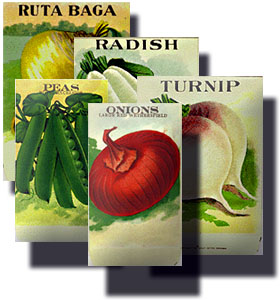
Sowing                                                                                                                  
 IT was a perfect day
As sweet and dry was the ground
As tobacco-dust.

I tasted deep the hour
Between the far                                                 
Owl's chuckling first soft cry
And the first star.

A long stretched hour it was;              
Nothing undone
Remained; the early seeds
All safely sown.

And now, hark at the rain,
Windless and light,
Half a kiss, half a tear,
Saying goodnight.


Last July's allotment - the point of it all.

Tuesday, March 11, 2014

Settings:Arras, Beaurains and Agny, Northern France


                       Arras 1919                                                                                                                        en.wikipaedia.com

Arras town square .  The ruined houses are as Edward Thomas described them in his war diary, the notebook he kept during the ten weeks he had in France.

The diary was discovered by the late Edward Cawston Thomas among his father, Merfyn's, papers and painstakingly transcribed. It was very difficult being written in small handwriting in a pocket-sized notebook, but you can try too, as it can be seen on the First World War digitalised Archive, University of Oxford. Professor George Thomas worked from a magnified version and I read it from his Collected Poems Annex.

The note-book was exhibited at the Imperial War Museum, in 2004 I think, all creased by the shell-blast that killed Edward Thomas.

Here he is on Arras: 'Afternoon to Arras.-Town Hall like Carreg Cennin. Beautiful small white square empty. Top story of high house ruined cloth armchair and a garment across it left as fly shell arrived. ... To Arras and began showing sectors and arcs on 1/10000 maps.  ...Place Victor Hugo white houses ans shutters and sharpened fuller and dome in middle. Beautiful.'

Much of Thomas's time was spent with his battalion in the village of Beaurains, or what was left of it. It was absolutely devastated by the war. Here is a picture from 1916


To write the First World War scenes in my novel I relied almost entirely on Thomas's War Diary, though the Imperial War Museum artefacts and 'trenches' lent detail and atmosphere. I did not  try to convey the broader reality of the War, which has been done so well by so many - I stayed with Thomas's recording of what he saw.
It's impossible not to believe that he would, as he always did, have used his notes for poems to be written:
Enemy plane like pale moth beautiful among shrapnel bursts.

A still starry night with only machine guns and rifles.

Sods on dug-out fledged with fine fronds of yarrow.

                                                     Hare, partridges and wild duck in field S.E. of guns.  The shelling must have slaughtered many jackdaws

but has made homes for many more.

           Blackbirds sing at battery.

 
Agny, in a small cemetery, is where he is buried.


Edward Thomas wrote no poems in France as far as we know. Just three lines which reflect an earlier poem, 'Roads'.

'Where any turn may lead to Heaven
Or any corner may hide Hell
Roads shining like river up hill after rain.'

                                                  _____________________________________________


 Aprilllll     
Preview
Preview

Wednesday, March 5, 2014


Edward Thomas and his dogs, real and in poems.

Irish Terrier

Rags, the dog the Thomases had during Edward's last four years, was an Irish Terrier. They grow long and shaggy coats- this one has clearly been 'stripped' a process of removing the hair by hand.
I love dogs so Rags does feature from time to time in the novel, thirteen times in fact. Here is one of them:


The children were all in a line, Baba holding her big brother’s and sister’s hands, wading back towards us along the muddy stream. They were soaked and their legs were dyed with the deep carmine stain of Leddington soil. We laughed.

‘Oh Edwy, we’ll try America if it’s what you want, but we must all be together. I can be happy anywhere then. ’

‘I know that, Helen. But then is it what I want? I have to think about what suits me and my work. It’s for your sake too. And it’s changing; I think I’ve gone astray all these years. But perhaps I’m getting nearer to finding myself, Helen, whatever that means.’

I put my arms round him, held him.

 The children stepped out of the water.

 ‘Hey, come here you scallywags and clean yourselves up on the grass. Your mother and I don’t want you dripping over us. Rags, clear off – no – Rags!’

Rags shook a great deal of the Ludstock Brook onto us, the water-drops leaping and sparkling across the glare of the sun and falling like rain, or like a blessing, on my hot skin.
                                                       *   *   *
I remember from Helen's Under Storm's Wing that Bronwen was given a bull terrier, but it had to go, being too much of a killer. Edward Thomas was, it seems, not at all fond of cats. Many bird lovers feel the same.
A Cat
She had a name among the children;
But no one loved though someone owned
Her, locked her out of doors at bedtime
And had her kittens duly drowned.

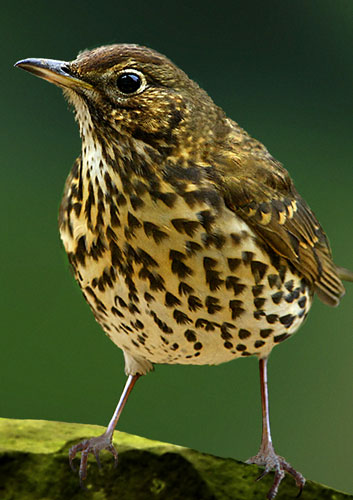
In Spring, nevertheless, this cat
Ate blackbirds, thrushes, nightingales,
And birds of bright voice and plume and flight,
As well as scraps from neighbours’ pails.

I loathed and hated her for this;
One speckle on a thrush’s breast
Was worth a million such; and yet
She lived long, till God gave her rest.


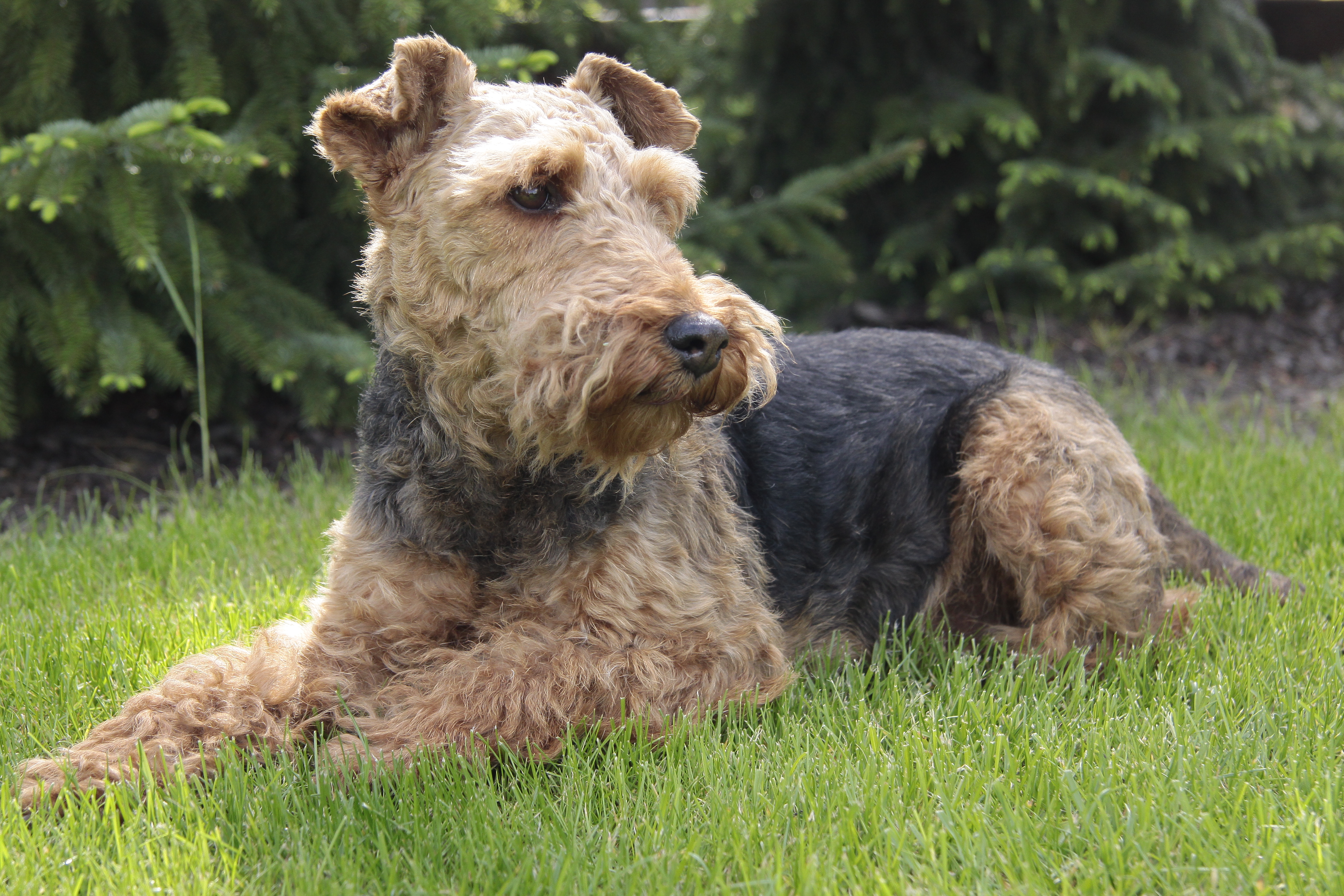
My favourite dog in the poems is the little  Welsh terrier in Man and Dog- or rather half-Welsh. We know from Thomas's notebook that the encounter took place in November 1914, the poem being written in January 1915. It is concerned with soldiers and the war, but this little episode stands aside from that.


'He laughed and whistled to the small brown bitch
With spots of blue that hunted in the ditch.
Her foxy Welsh grandfather must have paired
Beneath him. He kept sheep in Wales and scared
 Strangers, I will warrant, with his pearl eye
And trick of shrinking off as he were shy,
Then following close in silence for---for what?
'No rabbit, never fear, she ever got,
Yet always hunts. To-day she nearly had one:
She would and she wouldn't. 'Twas like that.
The bad one!
She's not much use, but still she's company, '
Though I'm not. She goes everywhere with me.


Monday, March 3, 2014

March 3rd, Edward Thomas' s Birthday.


The Edward Thomas Fellowship walk in celebration of ET's birthday was a great success- numbers greater than ever and a wider range of ages.

The highlight for me was being able to visit the garden to the side and back of the TYhomas's cottage and take photographs. The rain held off until late afternoon by which time we were in Steep Church for tea , the AGM and the Tribute to Thomas. It's good to see the newly restored window.

Some photos from the day- Monty our dog features often.

It had been raining! The usually little waterfall floods the road instead of going beneath it.


The last leg.


Yew Tree again- the rear window downstairs was Edward's 'home'  study.
 
The Poem - of course -
                                                   March the Third.

   'As a birthday poem written shortly before Easter, March the Third subverts Christian celebration by making 'holy' and 'wild' interchangeable. A draft of lines 15-16 likens the birds' songs to canticles. Thomas was dissatisfied with the poem:"Perhaps I shall be able to mend March the Third. I know it must either  be mended or ended." ' Edna Longley.
There is another March poem to come. 

Here again (she said) is March the third
And twelve hours singing for the bird
'Twixt dawn and dusk, from half past six
To half past six, never unheard.

'Tis Sunday, and the church-bells end
When the birds do. I think they blend
Now better than they will when passed
Is this unnamed, unmarked godsend.

Or do all mark, and none dares say,
How it may shift and long delay,
Somewhere before the first of Spring,
But never fails, this singing day?

And when it falls on Sunday, bells
Are a wild natural voice that dwells
On hillsides; but the birds' songs have
The holiness gone from the bells.

This day unpromised is more dear
Than all the named days of the year
When seasonable sweets come in,
Because we know how lucky we are.
 
. It's rather intriguing that the 3rd March, unnamed -  he means in the Christian calendar -  is the  big day for Edward Thomas enthusiasts, pagans, Christians, of  any or no faith at all.
 
NEWS
 
There is an Edward Thomas Fellowship Facebook site, going strong already. It is a closed group for members - but membership is easy and inexpensive. See edwardthomasfellowship.org.uk
 
StreetBooks is reprinting A Conscious Englishman, to be ready by late March. I'm pleased for two reasons - it will carry  Robert Macfarlane's  kind 'blurb' along with others, and it will eliminate the errors which I'm sorry to say I missed  first time around and which have embarrassed me hugely.