Friday, April 12, 2013

Still in Pursuit of Spring - Chapters V1 &V11


Edward Thomas's advice on writing?

These chapters show Thomas at his most relaxed, enjoying his cycling or walking  and his close observations. They are fairly random in nature - inscriptions on graves, always a source of irony for him, pub names and then overall, of course, signs of Spring.

Chiefly I find in these chapters a great deal about Edward Thomas and his process of observing and of writing. If you look hard you see that he is reflecting on those tenets of Creative Writing classes - 'people-watching' and 'always keeping a notebook', not always without ambivalence.


The Full- no longer Half- moon at Rudge, his starting point.

He prefers walking to cycling when there is mist - walking lets you 'see every small thing one by one',
 'the pale green larch plantation  where another chiff-chaff was singing, and the tall elm tipped by a linnet pausing and musing a few notes..every primrose and celandine and dandelion on the banks, every silvered gren leaf of honeysuckle up in the hedge, every patch of brightest moss, every luminous drop on a thorn tip.'


Elms - I chose this Wiltshire picture because I think I'm forgetting and some just don't know, how huge elms were and what a loss was suffered when they went.
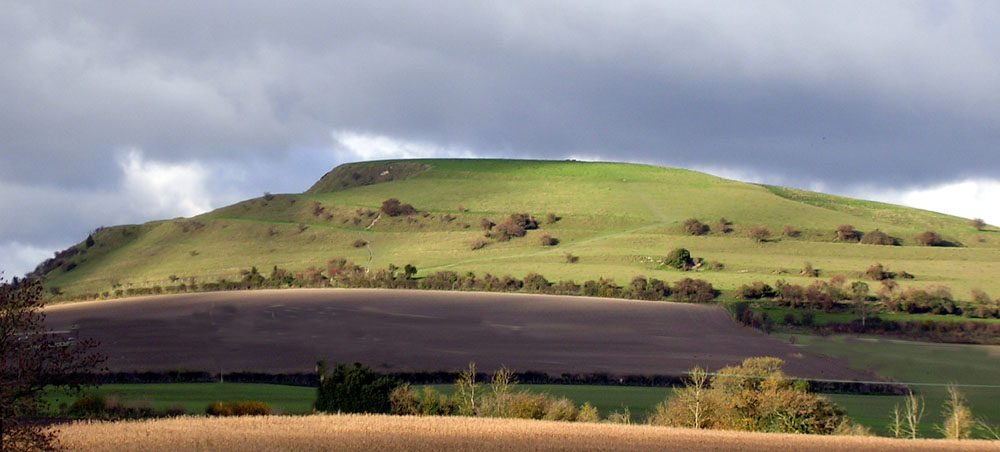
c. megalithic.com Cley Hill
'I saw the single bare hump of Cley Hill five miles away'

When he arrives at Trowbridge on a fine Easter Monday he  meets a sort of crowd leaving the town to walk in the country nearby. The passage gives us insight into his relation to people: he does not mind  groups from a country town like this, or a gathering at a village event  but he is uneasy and troubled by  the crowds that emerge from trains at Clapham junction:

'perhaps I ought to call my feeling fear: alarm comes first, followed rapidly by dislike. .....it is a disintegrated crowd, rather suspicious and shy perhaps, where few know, or could guess much about, the others. When I find myself among them, I am more confused and uneasy than in any other crowd. I cannot settle down in it to notice the three or four or half dozen types, as I should do at Swindon, or Swansea, or Coventry; nor yet please myself as with the general look of a village mob of forty or fifty,  and a few of the most remarkable individuals.


We easily forget that many of  Thomas's poems concern carefully observed 'remarkable individuals'.

More insights into his sense of himself follow as he cycles:

'It was as easy as riding in a cart, and more satisfying to a restless man. At the same time I was a great deal nearer to being a disembodied spirit than I can often be. I was not at all  tired, so far  as I knew. No people or thoughts embarrassed me. I fed through the senses directly, but very temporarily, through the eyes chiefly, and was happier than is extricable or seems reasonable.'

The chapter ends with one of the best known passages from In Pursuit:

‘I went out into the village at about half-past nine in the dark, quiet evening. A few stars penetrated the soft sky; a few lights shone on earth, from a distant farm seen through a gap in the cottages. Single and in groups, separated by gardens and bits of orchard, the cottages were vaguely discernible; here and there a yellow window square gave out a feeling of home, tranquillity, security. Nearly all were silent. Ordinary speech was not to be heard, but from one house came the sounds of a harmonium being played and a voice singing a hymn, both faintly. A dog barked far off. After an interval a gate fell-to lightly. Nobody was on the road....
  The pollard willows fringing the green, which in the sunlight resemble mops, were now very much like a procession of men, strange primeval beings, pausing to meditate in the darkness....
I felt that I could walk on thus, sipping the evening silence and solitude, endlessly. '


Bradford-on-Avon
 
Bradford -on-Avon, sitting in a small public park by the Avon, he meets again the Other Man, 'staring at the chapel on the bridge, and its weather-vane of a gilded perch.'
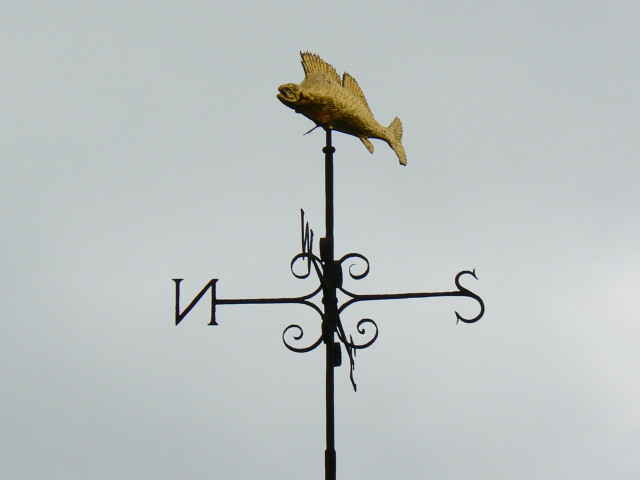


He was also going to Wells and they agreed to ride to ride together, though Thomas is clearly ambivalent. Did this Other Man exist? Perhaps at this point he does, though soon I begin to doubt again, or to confuse him so much with Thomas that it has crept into my novel unawares.  This man also writes topographical books, is concerned with how much they will pay, and crucially he notes everything in his notebooks.The Other Man 'rambled on and on':
 
'his  main point was that he did not like writing . He had been attempting the impossible task of reducing undigested notes about all sorts of details to a grammatical, continuous narrative. He abused notebooks violently. He said that they blinded him to everything that would not go into the form of notes; or at any rate, he could never afterwards reproduce the great effects of nature and fill in the interstices merely-which was all they were good for-from the notes.The notes - often of things which he would otherwise have forgotten- had to fill the whole canvas. Wheras, if he had taken none, then only the important, what he truly cared for, would have survived in his memory, arranged perhaps not as they were in Nature, but at least according to the tendencies of his own spirit.'
 
That last phrase suggests to me a vital element of poetry - something beyond mere description.
I feel fairly  certain  that Thomas himself had the same reservations about his notebook -keeping - maybe my idea came from In Pursuit of Spring.
 
An extract from the novel: a sprained ankle is confining him to the house. 
'Memory must be his source – his memory and his field notebooks, which he had Helen fetch from the Cockshott Lane study. He had always kept a notebook everywhere he went, and the detail, the thoughts he’d had, the conversations with solitary strangers on the road, fed him with ideas. Sometimes he told himself that if he stopped using notebooks, if he only looked, allowed himself to experience passionately what he encountered, it would be better. It might free him from that sense he often had that he was nothing but a remote observer, a ghost invisible to other people. Perhaps, too, without a notebook he would remember only the poignant, vital aspects of what he encountered instead of risking losing that significance in a mass of detail. But he could not break the habit now – it was part of who he was.'
 
They ride on but glide down the steep hills to part at the town of Shepton Mallett in the Mendip Hills of Somerset. Edward Thomas mentions the prison:
'The stone prison and all its apertures, like a great wasps' nest, was a punishment to look at in the darkness.' 
In the course of work I've visited this 400 year-old prison - or rather prisoners in it - and have a half-recollection of a prison officer showing me the old gallows there - I had an unpleasant feeling that he was regretting the 'good old days'. there.
HMP Shepton Mallett has actually been just closed down this month, not before time. But what on earth can they do with it? Not sure it would convert to a hotel and art gallery like little Oxford Prison, of which I was rather fond.

HMP Shepton Mallett


But Shepton Mallett town gives Edward a pleasant  evening  and a night's rest at a temperance hotel ( four shillings for supper, bed and breakfast):
 
'I found a good fire and peace in the company of a man who studied Bradshaw. With the aid of maps I travelled my road again, dwelling chiefly on Tellisford, its white bridge over the Frome, the ruined mill and cottage, the round tower of Vaggs Hill Farm, and the distinct green valley which enclosed them, and after this, the Nettlebridge Valley and the dark house above it.'
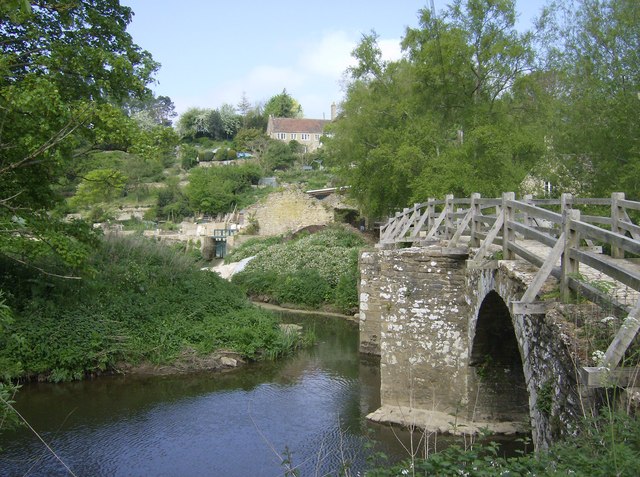
 
Tellisford Bridge. c geograph.org


---------------------------------------------------------------------------------------------------------------------------------------------

 
 To buy A Conscious Englishman direct from the publisher - info@streetbooks.co.uk
 
Follow Thomas's route with this link, from Laurel Books whose new edition of In Pursuit of Spring was used by Matthew Oates for his broadcasts.
 
 Poem.

Not 'The Other' which is more complex than the Other Man     ('He was like me in general./He had pleased them, but I less.)

There are several poems that are observations of 'remarkable individuals':
The Gypsy, The Huxter, Man and Dog, Up in the Wind of course, The New Year, A Gentleman and the marvellous Jack Noman in

                           May 23rd


THERE never was a finer day,
And never will be while May is May,--
The third, and not the last of its kind;
But though fair and clear the two behind
Seemed pursued by tempests overpast;
And the morrow with fear that it could not last
Was spoiled. To-day ere the stones were warm
Five minutes of thunderstorm
Dashed it with rain, as if to secure,
By one tear, its beauty the luck to endure.
 
At mid-day then along the lane
Old Jack Noman appeared again,
Jaunty and old, crooked and tall,
And stopped and grinned at me over the wall,
With a cowslip bunch in his button-hole
And one in his cap. Who could say if his roll
Came from flints in the road, the weather, or ale?
He was welcome as the nightingale.
Not an hour of the sun had been wasted on Jack
"I've got my Indian complexion back"
Said he. He was tanned like a harvester,
Like his short clay pipe, like the leaf and bur
That clung to his coat from last night's bed,
Like the ploughland crumbling red.
Fairer flowers were none on the earth
Than his cowslips wet with the dew of their birth,
Or fresher leaves than the cress in his basket.
"Where did they come from, Jack?" "Don't ask it,
And you'll be told no lies." "Very well:
Then I can't buy." "I don't want to sell.
Take them and these flowers, too, free.
Perhaps you have something to give me?
Wait till next time. The better the day . . .
The Lord couldn't make a better, I say;
If he could, he never has done."
So off went Jack with his roll-walk-run,
Leaving his cresses from Oakshott rill
And his cowslips from Wheatham hill.
'Twas the first day that the midges bit;
But though they bit me, I was glad of it:
Of the dust in my face, too, I was glad.
Spring could do nothing to make me sad.
Bluebells hid all the ruts in the copse.
The elm seeds lay in the road like hops,
That fine day, May the twenty-third,
The day Jack Noman disappeared.


To follow route with Laurel Books, publisher of a new In Pursuit of Spring Edition see


www.inpursuitofspring.co.uk/

To buy A Conscious Englishman direct from the publisher,

info@streetbooks.co.uk     www.streetbooks.co.uk


Sunday, April 7, 2013

In Pursuit of Spring 4, Three Wessex Poets.


Blackmore Vale, Dorset

I had intended to skip this section, a diversion into literary criticism from the journey westwards. But as so often with Edward Thomas, there was more to enjoy and to think about than I had expected.

The three poets chapter moves naturally from the very obscure to the famous - from one Stephen Duck(qui?) to William Barnes, who I've heard of, to Thomas Hardy.

Stephen Duck - well you could have knocked me down with a feather - I found that he features on my favourite pod-cast source, the English Lit Dept, University of Oxford podcasts, Great Writers Inspire Series! (Yes I 'm a Eng Lit junkie) . So you can hear a short lecture about him right now should you wish, but I'll focus on what Thomas had to say.


Stephen Duck(1705 - 1756)
'Briefly, in 1730, the most talked about poet in England was an agricultural labourer. The story of Stephen Duck is a remarkable one, as the title page of the unauthorised collection of his verse, Poems on Several Subjects, explains. He was 'lately a poor Thresher in a Barn in the County of Wilts, at the Wages of Four Shillings and Six Pence per Week' until his poems
"were publickly read by The Right Honourable the Earl of Macclesfield, in the Drawing-Room at Windsor Castle, on Friday the 11th of September, 1730, to her Majesty. Who was thereupon most graciously pleased to take the Author into her Royal Protection, by allowing him a Salary of Thirty Pounds per Annum, and a small House at Richmond in Surrey, to live in, for the better Support of Himself and Family."'

I remembered that Thomas had written appreciatively, in 'A Literary Pilgrim in England', about John Clare, much better known, for me, as a farm-worker-poet, 'goose-tending at seven, threshing and following the plough before he was in his teens.'
Duck was born almost a century earlier and was perhaps unfortunately constrained by the then current 'Pastoral' tradition to write about nymphs and shepherds with fancy names rather than what he might have written using his own experience. Sometimes he could, as in his description of threshing, so that Thomas says,
'Somethings he did write that were true and were unlikely to have been written by anyone else. If he could have thrown Cuddy and Chloe on to the mixen and kept to the slighted homely style...Instead of merely writing as if he had been to Oxford, he might have reached men's ears.'

Then there is William Barnes, always called the Dorset dialect poet - I recall he has a statue in Dorchester.
I knew this one - but in another guise entirely - the rather lovely Linden Lea.


William Barnes


My Orcha’d in Linden Lea.
.                                
'Ithin the woodlands, flow’ry gleäded,
By the woak tree’s mossy moot,
The sheenèn grass-bleädes, timber-sheäded,
Now do quiver under voot;
An’ birds do whissle over head,
An’ water’s bubblèn in its bed,
An’ there vor me the apple tree
Do lean down low in Linden Lea.
 
When leaves that leätely wer a-springèn
Now do feäde ’ithin the copse,
An’ païnted birds do hush their zingèn
Up upon the timber’s tops;
An’ brown-leav’d fruit’s a-turnèn red,
In cloudless zunsheen, over head,
Wi’ fruit vor me, the apple tree
Do leän down low in Linden Lea.
 
Let other vo’k meäke money vaster
In the aïr o’ dark-room’d towns,
I don’t dread a peevish meäster;
Though noo man do heed my frowns,
I be free to goo abrode,
Or teäke ageän my hwomeward road
To where, vor me, the apple tree
Do leän down low in Linden Lea.

The 'standardised' version has  music by Ralph Vaughan-Williams. You can hear it on YouTube.


I have been hunting for something else - the words of a 70's sea-side postcard which my children used to recite in as comic a 'Darset' accent as they could - I bet they still remember it - it began

'Ave 'e bin on Darset cliff-tops
Looked on lovely coves(?) below?'

 and had an old chap, neckerchief and straw in mouth  - what stereotyping went on then.    I've always assumed it was William Barnes but can't track it down.
           ps Just as I thought, and passing down another generation:

'Here it is - the postcard's still going strong as I think Izi and Felix once sent me one. And yes I do know the words! deborah x '
 
Maybe not Barnes after all. The first card keeps disappearing - so trying
another version
...Ere's greetens vrom Darzet


Ave 'ee bin on Darzet cliff tops
Looked on luvly coves below
Watched tha zhips from other waters
Buzy goin' to an' fro

Rugged beaches, caves an' inlets
Girt arched rock ov Durdle Door
Meakes 'ee think ov many a zmuggler
Luggin' loot up on tha zhore

Nowadaays tiz lobster-catchin'
'Do 'ee vancy oone vor tea?
Anywaay I guess that Darzet's
Jist the pleace vor' ee ta zee.

Edward Thomas comments that Barnes was in fact a schoolteacher, then a clergyman and a pillar of the community - none-the-less he thinks Barnes was right to use the dialect and that the poems have a validity of their own.
another version


Then there's  Thomas Hardy                          
Hardy's birthplace & my own old 'Literary Pilgrim' book


What immediately struck me was the date Thomas was writing, Spring 1913.

The poems of Hardy's that he was considering couldn't include what most people regard as Hardy's best, the 'Emma poems' of 1912 - 13, poems of grief and remorse following the death of his wife whom he 'd come to neglect and despise. I assume that Edward never saw them, published as they were in Moments of Vision, 1917. I think he would have understood only too well.

Young Emma

His comments on the poems he has - the Dynasts and the satires, chiefly, relate to what he calls an 'obsession' with the' blindness of Fate, the carelessness of Nature and the insignificance of Man, crawling in multitudes like caterpillars, twitched by the Immanent Will hither and thither .' He deplores this emphasis in Hardy.

This made me think immediately of a poem of Thomas's - it appears in my novel:

'He thought of his sonnet written a year before, February Afternoon, where ploughing still continued in spite of war. It was true even here: a few elderly men were still ploughing in the fields nearby, following the ancient boundaries. Man and the plough and the gulls and starlings that followed them had existed for a thousand years and would for another thousand, while wars were fought and an indifferent, stone-deaf, stone-blind God looked down on it all. '

But now, perhaps because of what he knew of war, Thomas seems to be taking the same position.

Poems:

February Afternoon
 

MEN heard this roar of parleying starlings, saw,
A thousand years ago even as now,
Black rooks with white gulls following the plough
So that the first are last until a caw
Commands that last are first again,--a law
Which was of old when one, like me, dreamed how
A thousand years might dust lie on his brow
Yet thus would birds do between hedge and shaw.
Time swims before me, making as a day
A thousand years, while the broad ploughland oak
Roars mill-like and men strike and bear the stroke
Of war as ever, audacious or resigned,
And God still sits aloft in the array
That we have wrought him, stone-deaf and stone-blind.


And Hardy's, The Voice or Woman much missed


Woman much missed, how you call to me, call to me,
Saying that now you are not as you were
When you had changed from the one who was all to me,
But as at first, when our day was fair.


Can it be you that I hear? Let me view you, then,
Standing as when I drew near to the town
Where you would wait for me: yes, as I knew you then,
Even to the original air-blue gown!


Or is it only the breeze, in its listlessness
Travelling across the wet mead to me here,
You being ever dissolved to wan wistlessness,
Heard no more again far or near?


Thus I; faltering forward,
Leaves around me falling,
Wind oozing thin through the thorn from norward,
And the woman calling.

                                                   -------------------------------------------------------

Publishing Matters - a surprise sent on to me by Frank Egerton. 

'Guardian Books, 5th April 2013:Reader reviews roundup

A biographical novel about the poet Edward Thomas
Edward Thomas
Bardly behaved? … Edward Thomas. Photograph: EO Hoppe/Corbis
Hello and welcome back to our reader reviews roundup, which returns after a two-week easter break. Though the books desk might have been slacking, our reader reviewers have not.

One of the liveliest conversations has been inspired by a novel about the poet Edward Thomas. It was published in February by the Oxfordshire-based "micro-publisher" Streetbooks, whose founder Frank Egerton says: "My interest is in artisan publishing: which involves high quality, regional fiction, marketed locally in person and globally via the Internet. An analogy I like is that of the micro-brewery: a combination of tradition, passion and the opportunities offered by new technology."


Frank of StreetBooks.com

A Conscious Englishman is by former teacher and probation officer Margaret Keeping, and either she has some very conscientious literary friends or her publisher's micro-brewery policy is producing some pretty heady results in the Edward Thomas fan club.
First to review it was ISWilton, who wrote:
What I love most about this book is the voice of his wife Helen. Much of the book is told from her viewpoint and we understand the pain of being married to a struggling, and sometimes, difficult artist.
Next came Georgeed, who felt Keeping conveyed Thomas's love of the English countryside particularly well.
evmason wrote the clincher over Easter weekend:
Her gift is to create in prose the landscapes and moods which Thomas captured in his poems. In showing us the genesis of 'The Manor Farm', 'Old Man', 'In Memoriam (Easter 1915)', she sends us straight back to the poetry, and for a writer who loves Thomas's work, what finer service could she render?
Definitely worth checking out then.'
                                 -------------------------------------------------------------------------


Friday, April 5, 2013

In Pursuit of Spring, 3 - in Surrey.


By one of those strange coincidences I had to visit on Wednesday the area of Thomas's first, London to Guildford, stretch - somewhere I've never been before. (It was a 'buyer collects' ebay purchase.)

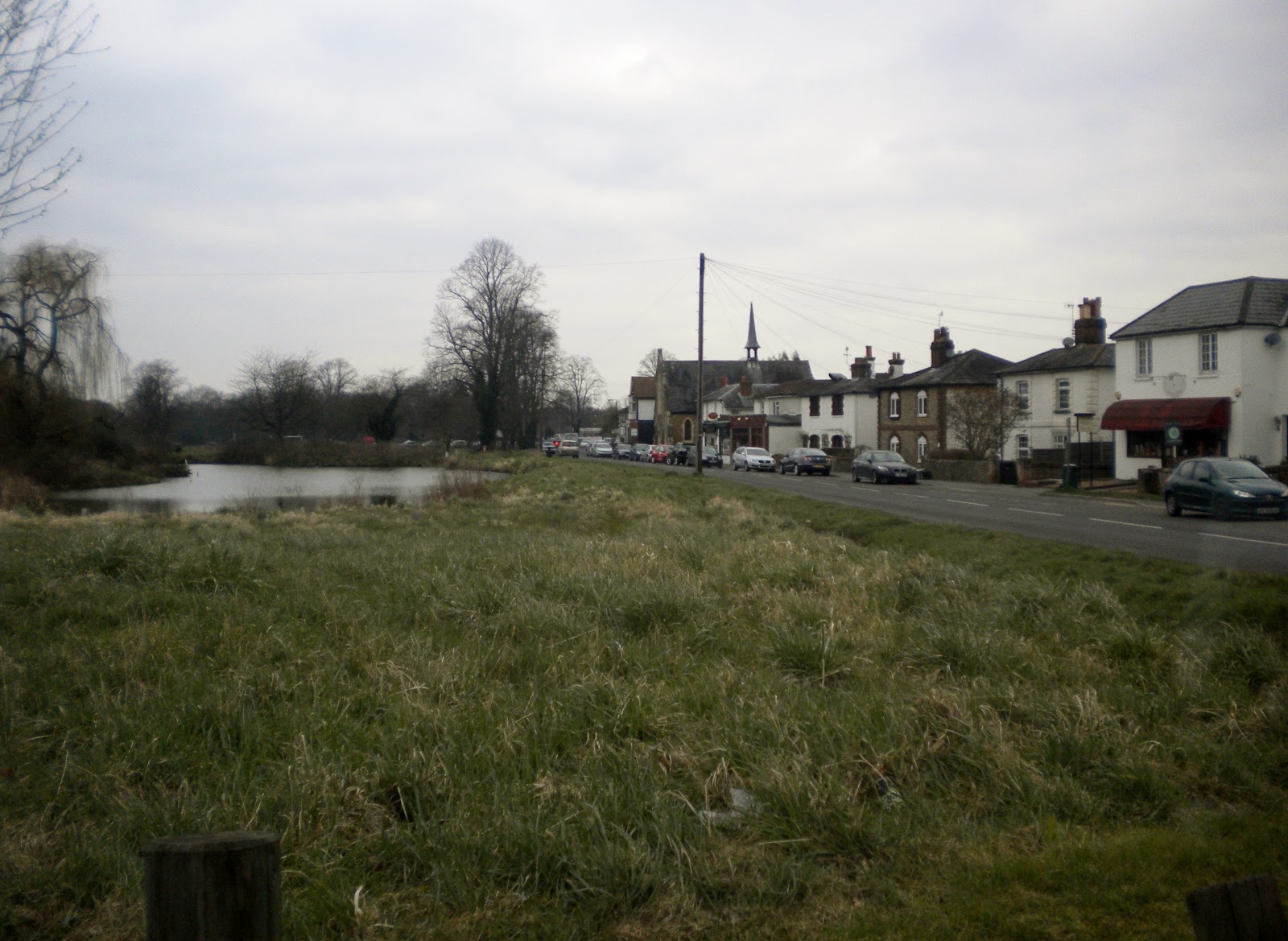
We didn't have much time, but were able to visit first SHALFORD
The Common


'Crossing the little railway from the mills, I came
in sight of the Hog's Back, by which I must go
to Farnham. That even, straight ridge pointing
westward, and commanding the country far away
on either side, must have had a road along it since
man went upright, and must continue to have one
so long as it is a pleasure to move and to use the
eyes together. It is a road fit for the herald Mer-
cury and the other gods, because it is as much in
heaven as on earth. The road I was on, creeping
humbly and crookedly to avoid both the steepness
of the hills and the wetness of the valley, was by
comparison a mole run. Between me and the
Hog's Back flowed the Wey, and as the Tilling-
bourne approached it the valley spread out and
flattened into Shalford's long, wet common. My
road crossed the common, a rest for gypsies and
their ponies. Shalford village also is on the flat,
chiefly on the right hand side of the road, nearer
the hill, and away from the river, so that its out-
look over the levels gives it a resemblance to a
seaside village. Instead of the sea it had formerly
a fair ground of a hundred and forty acres. Its inn
is the " Queen Victoria " charmless name. ' IPS. (Still there)


Cold grey day in Shalford.


The North Downs


The North Downs , or the Surrey Hills, are more wooded and attractive than I would have imagined. Proportional to its size, Surrey is the most wooded county in England.
 
'The Downs were beginning to
give me some shelter, and I went on under them,
glad of the easier riding. The Tillingbourne here
was running closer under the Downs, and the river
level met the hillside more sharply than before.
The road bent above the meadows and showed them
flat to the very foot of a steep, brown slope covered
with beeches. The sky lightened lightened too
much : St. Martha's tower, almost reaching up into
the hurrying white rack, was dark on its dark hill.
So I came to Albury, which has the streamlet be-
tween it and the Downs, unlike Abinger Hammer,
Gomshall, and Shere. The ground, used for vege-
tables and plum trees, fell steeply down to the
water, beyond which it rose again as steeply in a
narrow field bounded horizontally by a yet steeper
strip of hazel coppice ; beyond this again the rise
was continued in a broader field extending to the
edge of the main hillside beech wood. Albury is
one of those villages possessing a neglected old
church and a brand-new one. In this case the
new is a decent enough one of alternating flint
and stone, built among trees on a gradual rise.
But the old one is too much like a shameless un-
buried corpse.

Twice I crossed the Tillingbourne, and came to
where it broadened into a pond. This water on
either side of the road was bordered by plumed
sedges and clubbed bulrushes. At the far side,
under the wooded Downside crowned by St. Martha's,
was a pale, shelterless mill of a ghostly bareness.
The aspens were breaking into yellow-green leaves
round about, especially one prone aspen on the left
where a drain was belching furious, tawny water into
the stream, and shaking the spears of the bulrushes.

As I went on towards Chilworth, gorse was blos-
soming on the banks of the road. Behind the
blossom rose up the masses of hillside wood, now
scarcely interrupted save by a few interspaces of
lawn-like grass.' IPS.
 
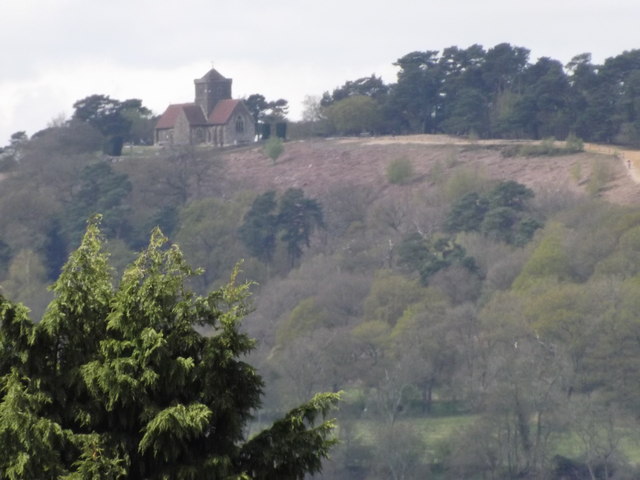
 www.geograph.com   St Martha's Church, Albury.
 
Albury sits in the south side at the foot  of the Downs. I liked this farm and the fisheries on the Albury Estate.:


But it was so bitterly cold that it was a pleasure to drive up the Downs to Newlands Corner and its Visitors' Centre.
 
And to take some more chilly-looking pictures:


'At first, [the Downs}
  were thoroughly tamed,
their smoothness made park-like, their trees mostly
fir. Beyond, their sides, of an almost uniform
gentle steepness, but advancing and receding,
hollowed and cleft, were adorned by unceasingly
various combinations of beech wood, of scattered
yew and thorn, of bare ploughland or young corn,
and of naked chalk.' IPS.
 
The warden told us that the weather was having a deleterious effect on the wildlife - migrating birds not arriving, 'not knowing where they are.'  We are complaining about the weather - inconvenient for us - but serious for the mammals and birds. An article in the Observer comments:
 
"Britain's continued freezing weather is threatening ever greater numbers of wild animals, birds and insects across the country, experts have warned. The current cold spell – one of the longest on record – is particularly affecting creatures that are already struggling to survive the loss of their habitats and changes in climate.
Examples include the hedgehog, which has already suffered a devastating loss of numbers over the past three decades and is now badly affected by the cold weather. In addition, threatened reptiles such as the grass snake and slowworm require sunny, warm conditions when they emerge from hibernation. Such a prospect is still remote, say meteorologists.
... 
For hedgehogs, the prolonged cold weather has had a particularly severe impact. "Many animals that went into hibernation in November or December last year are still sleeping," said Fay Vass, chief executive of the Hedgehog Preservation Society. "The weather is not yet warm enough to wake them. Usually they would be up and about by now."
The problem was that the longer a hedgehog remained asleep, the weaker it got and the less energy an animal had to restore itself to wakefulness, added Vass. "It depends just how healthy and well-fed an animal was when it went into hibernation. But in general, the longer the cold weather lasts, the greater the number of animals that will not wake up at all."
 
Experts stress that the public can help. The RSPB has urged householders to keep bird feeders regularly topped up with high-energy, high-fat food and to keep water dishes filled. Similarly, the Hedgehog Preservation Society recommends leaving plentiful water supplies and also food, either meaty cat or dog meals or specialist hedgehog food."

Another article specifically mentions the chiff-chaff's lateness this year.

The drive from here into London, our destination, probably traced some of Thomas's route - near Epsom, and in through Wandsworth, but apart from the ever-flowering gorse, not really recognisable.

Poems:  Shelley: Winter

It was a winter such as when birds die
In the deep forests; and the fishes lie
Stiffened in the translucent ice, which makes
Even the mud and slime of the warm lakes
A wrinkled clod as hard as brick; and when,
Among their children, comfortable men
Gather about great fires, and yet feel cold:
Alas, then, for the homeless beggar old!      


Another bird poem, in which Edward Thomas positively relishes winter.

Bird's Nests

The summer nests uncovered by autumn wind,
Some torn, others dislodged, all dark,
Everyone sees them: low or high in tree,
Or hedge, or single bush, they hang like a mark.

Since there's no need of eyes to see them with
I cannot help a little shame
That I missed most, even at eye's level, till
The leaves blew off and made the seeing no game.

'Tis a light pang. I like to see the nests
Still in their places, now first known,
At home and by far roads. Boys knew them not,
Whatever jays and squirrels may have done.

And most I like the winter nests deep-hid
That leaves and berries fell into:
Once a dormouse dined there on hazel-nuts,
And grass and goose-grass seeds found soil and grew.
                                                                 * * *
 
 Publishing Matters - a surprise sent on to me by Frank Egerton today, 6th April.

'Guardian Books, 5th April 2013:Reader reviews roundup

A biographical novel about the poet Edward Thomas 
Edward Thomas
Bardly behaved? … Edward Thomas. Photograph: EO Hoppe/Corbis
 
Hello and welcome back to our reader reviews roundup, which returns after a two-week easter break. Though the books desk might have been slacking, our reader reviewers have not.

One of the liveliest conversations has been inspired by a novel about the poet Edward Thomas. It was published in February by the Oxfordshire-based "micro-publisher" Streetbooks, whose founder Frank Egerton says: "My interest is in artisan publishing: which involves high quality, regional fiction, marketed locally in person and globally via the Internet. An analogy I like is that of the micro-brewery: a combination of tradition, passion and the opportunities offered by new technology."
A Conscious Englishman is by former teacher and probation officer Margaret Keeping, and either she has some very conscientious literary friends or her publisher's micro-brewery policy is producing some pretty heady results in the Edward Thomas fan club.
First to review it was ISWilton, who wrote:
What I love most about this book is the voice of his wife Helen. Much of the book is told from her viewpoint and we understand the pain of being married to a struggling, and sometimes, difficult artist.
Next came Georgeed, who felt Keeping conveyed Thomas's love of the English countryside particularly well.
evmason wrote the clincher over Easter weekend:
Her gift is to create in prose the landscapes and moods which Thomas captured in his poems. In showing us the genesis of 'The Manor Farm', 'Old Man', 'In Memoriam (Easter 1915)', she sends us straight back to the poetry, and for a writer who loves Thomas's work, what finer service could she render?
Definitely worth checking out then.' 

                             ---------------------------------------------------------------------------
 I'm glad to say that people I do know personally have all, without exception, also said how much they enjoyed it. Some knew a great deal about Edward Thomas, others very little.

This is the full evmason review:
Timely, Shapely.
2014 sees the 100th anniversary of the First World War; attention will be paid to the writers who remind us. Already the London stage has hosted a play about Edward Thomas, and this Easter the BBC begins readings from his book 'The Pursuit of Spring'. Margaret Keeping's 'A Conscious Englishman' is timely.
Her research is impeccable and she is scrupulous in indicating when she is quoting directly from letters, diaries, poems; where she must imagine, she convinces. Biography can be shapeless, but here the problem is solved by structuring the book around Thomas's search for an answer to the tormenting question - how should he respond to war? This sharp focus excises undigested lumps of research, much to this reader's pleasure. (It could be argued that the relationship with Edna Clarke-Hall is a diversion, but you have only to track her photograph on the internet to understand her allure.)
Helen Thomas has written devotedly of her marriage, and although to a later generation it may lack attraction, Margaret Keeping is wise and generous enough to understand that where both parties have needs which are being met, third-party censoriousness is inappropriate. Her Helen is allowed to speak, and her voice is an engaging one.
Above all, Thomas is a poet of those spots of time - in Margaret Keeping's words, those "moment[s] out of time that could contain something everlasting, a rapturous moment, always remembered." Her gift is to create in prose the landscapes and moods which Thomas captured in his poems. In showing us the genesis of 'The Manor Farm', 'Old Man', 'In Memoriam (Easter 1915)', she sends us straight back to the poetry, and for a writer who loves Thomas's work, what finer service could she render?
-------------------------------------------------------------------

Another surprise review on Amazon - I hadn't been checking:

A good read, 24 Mar 2013

This review is from: A Conscious Englishman (Paperback)
'This excellent book about the important but often overlooked Anglo-Welsh poet Edward Thomas, can be delightful. We experience the blossom of spring, the smell of apples and perry pears, him pushing his children on the swing in the orchard above the wide Gloucestershire fields. And there are some touching, not to mention passionate, moments with his wife Helen.
Margaret Keeping writes very skilfully, achieving some most economical character studies - 'Edward complained I treated everyone as if they were my children and they did not like that. It was nonsense, I was interested in people and hoped they would like me.' One can just see this bustling, fussing albeit well-meaning person driving everyone mad. But one can also see what an anchor she was to Thomas.
The book is an account of their relationship and the relationship with other literary greats of the day, particularly Robert Frost. It is also, of course, the story of Thomas's heart searching and indecision as he clambered to brief fame as a poet, and as such it deftly portrays selfishness, depression and anger.
Most of the narrative is in the third person, but some sections are given to Helen, which is effective in contrasting the down to earth practical point of view of a mother with that of an artist prepared to give up so much for his art. It points up both aspects and increases the feeling of reality in the story.
I would recommend this book to anyone who is interested in poetry, particularly turn of the century poets, English/Welsh rural life, or just a good read. '

      -------------------------------------------------------------------------------------------------------
The Weather: After my long complaint about the weather,  Spring arrived at last on the 6th of April.

What a difference three days has made, in Oxford at least. No change in the vegetation just yet but at least  the people were out in force in Christchurch Meadows. 


Monday, April 1, 2013

In Pursuit of Spring - 3


Further West, and birds.


The Lark Ascending, kind permission of Keith Tilley, Painting on the Edge blog.
 

So many birds in 'In Pursuit of spring' as in Thomas's poetry.

They represent  a form of language, a clear true language, and freedom. I remember Robert MacFarlane suggesting that, in contrast to, or balance with, the 'staying put' of trees, birds represent the drive to 'move on'. This was a constant tension for Thomas:  to leave home and then to long to be there again.
The movement is of course  especially true of the spring and summer visitors. It is these birds that receive special attention in 'In Pursuit...'

Still in London, rooks and blackbirds dominate. I associate Thomas with blackbirds - he mentions them often and as a Londoner they would have been very familiar in gardens, even more so than now.
British Trust for Ornithology.


The first birds he encounters are Londoners and prisoners - a parrot who 'sings sweet street songs of twenty years before', and the finches and linnets in cages, in a dismal shop. 'Battered ones a shilling, a neater one at eighteenpence.' Poor goldfinches bloodied from flinging themselves at the bars. The odd Other Man buys a finch, in a paper bag, and releases it. Is this Other Man really Thomas himself? I think he may be.


Here are four extracts from the novel in which both birds and trees feature and perhaps balance each other. There were many more.


He looked around. A trickle from a smaller stream entered Preston Brook. White chickens pecked among the roots of an ash tree; they squeezed through the hedge from a farmhouse he could just see through the elms. The hedge was blackthorn skilfully laid, the clean scars of the labourer’s hook still visible.  He listened. The only sounds were of the stream, the birds and the trees – their own pure and individual languages, never straining for effect, never false. He thought about the many languages, man’s one among many. Was it possible that a man’s words could have that kind of truthfulness?

                                                                                      *

He went for a walk in the misty stillness of evening. Something in the birds’ songs, the single spirit of their singing together, and the calm after London, was like a welcome. He had a sense that he and the birds of Steep were one, that his needs and pleasures were at one with theirs and that he was home. A labourer walked with a slow heavy tread and turned into the thatched wood-shed beside his white cottage. Soon afterward a rhythmic sound of sawing from the man’s shed and the birds had fallen silent. He was home, among country people and thrushes and chaffinches and the oaks and elms that were their homes.

                                                                                *

He worked on new verses – a poem on beauty he began in January, another on sedge warblers, and one about a cuckoo. Birds had enormous significance, a kind of holy importance for him. He felt that their place in nature was always as it should be, not like man’s place, so often destructive, or false, or discontented, and that they were users of a language too as he was.

                                                                          *

He kept a notebook-cum-diary of course, making observations about the surprises of spring, this spring that manifested itself even under fire. The birds especially seemed determined to sing, to mate, to soar in the sky, in spite of it all. For him and for many of the men, the countrymen among them, they were signs of hope and reminders of home. So too was the emerging landscape, the rounded chalk hills with small clumps of trees on their tops. It was as if he could take a sudden turn into a secret path and find himself in Steep.


In Pursuit of Spring: As he moves from suburbs into the country there are more birds - blackbirds of course, thrushes, jackdaws at Guildford castle, rooks everywhere - and so many larks. To me larks are relatively rare - I know where they can be found reliably, especially on Dorset hills near the sea, but  have to make a special effort to go to see and hear them.
 
Chiff-chaff
British Trust for Ornithology
Edward Thomas listens for the chiff-chaff call as a marker that spring is here, and remembers an early arrival when he was nineteen - no doubt recorded in 'The Woodland Life.'  After Bentley in Hampshire, in the park of a large house:
'...here, and at eleven o'clock, I first heard the chiff-chaff saying, "Chiff-chaff, chiff-chaff, chiff-chaff, chiff!"
My guide says:'Their song is heard from early March; birdwatchers listen eagerly for it as a sign of spring.'

As he travels over Salisbury Plain he hears and sees 'pewits' (peewits, lapwings) over a river : they 'wheeled over it with creaking wings and protests against the existence of man.'
Linnets twittered, thrushes sang and larks 'rose and fell unceasingly over Dean Hill.' Then near West Grimstead :
'A thrush and and several larks were singing and through their songs I heard a thin voice that I had not heard for six months, very faint yet unmistakeable, though I could not at first see the bird - a sand-martin. On such a morning one sand-martin seems enough to make a summer, and here were six, flitting in narrow circles like butterflies with birds' voices.'
 

British Trust for Ornithology- lapwing


Sand-martin, BTO picture

The most numerous things on Salisbury plain  'next to the dead' - 'sheep, rooks, pewits and larks. Today they mingle their voices, but the lark is the most constant.'

Skylark - Telegraph picture
POEMS

For a change  Gerard Manley Hopkins' The Sea and the Skylark
ON ear and ear two noises too old to end
Trench—right, the tide that ramps against the shore;
With a flood or a fall, low lull-off or all roar,
Frequenting there while moon shall wear and wend.
Left hand, off land, I hear the lark ascend, 5
His rash-fresh re-winded new-skeinèd score
In crisps of curl off wild winch whirl, and pour
And pelt music, till none ’s to spill nor spend.
How these two shame this shallow and frail town!
How ring right out our sordid turbid time, 10
Being pure! We, life’s pride and cared-for crown,
Have lost that cheer and charm of earth’s past prime:
Our make and making break, are breaking, down
To man’s last dust, drain fast towards man’s first slime.
 
 A marvellous account of the bird and its song (- the last line perhaps too strong, but for depression he could outdo even Edward Thomas.)

For Thomas's poem, there are several to choose from:The Thrush, The Cuckoo, The Owl, The Unknown Bird(rare for Thomas not to be able to identify), Sedge-Warblers, and
 
 Two Pewits
     Under the after-sunset sky
Two pewits sport and cry,
More white than is the moon on high
Riding the dark surge silently;
More black than earth. Their cry
Is the one sound under the sky.
They alone move, now low, now high,
And merrily they cry
To the mischievous Spring sky,
Plunging earthward, tossing high,
Over the ghost who wonders why
So merrily they cry and fly,
Nor choose 'twixt earth and sky,
While the moon's quarter silently
Rides, and earth rests as silently.
Starlings (photo copyright: John Harding/BTO)
Lapwings (photo copyright: John Harding/BTO)


Publishing matters: these are genuine reviews. I'm glad to say that people I do know personally have all, without exception, also said how much they enjoyed it. Some knew a great deal about Edward Thomas, others very little.

30 March 2013 1:07PM A marvellous review on the Guardian web-site, Saturday
Timely, Shapely.
2014 sees the 100th anniversary of the First World War; attention will be paid to the writers who remind us. Already the London stage has hosted a play about Edward Thomas, and this Easter the BBC begins readings from his book 'The Pursuit of Spring'. Margaret Keeping's 'A Conscious Englishman' is timely.
Her research is impeccable and she is scrupulous in indicating when she is quoting directly from letters, diaries, poems; where she must imagine, she convinces. Biography can be shapeless, but here the problem is solved by structuring the book around Thomas's search for an answer to the tormenting question - how should he respond to war? This sharp focus excises undigested lumps of research, much to this reader's pleasure. (It could be argued that the relationship with Edna Clarke-Hall is a diversion, but you have only to track her photograph on the internet to understand her allure.)
Helen Thomas has written devotedly of her marriage, and although to a later generation it may lack attraction, Margaret Keeping is wise and generous enough to understand that where both parties have needs which are being met, third-party censoriousness is inappropriate. Her Helen is allowed to speak, and her voice is an engaging one.
Above all, Thomas is a poet of those spots of time - in Margaret Keeping's words, those "moment[s] out of time that could contain something everlasting, a rapturous moment, always remembered." Her gift is to create in prose the landscapes and moods which Thomas captured in his poems. In showing us the genesis of 'The Manor Farm', 'Old Man', 'In Memoriam (Easter 1915)', she sends us straight back to the poetry, and for a writer who loves Thomas's work, what finer service could she render?

-------------------------------------------------------------------

Another surprise review on Amazon - I hadn't been checking:

A good read, 24 Mar 2013

This review is from: A Conscious Englishman (Paperback)
'This excellent book about the important but often overlooked Anglo-Welsh poet Edward Thomas, can be delightful. We experience the blossom of spring, the smell of apples and perry pears, him pushing his children on the swing in the orchard above the wide Gloucestershire fields. And there are some touching, not to mention passionate, moments with his wife Helen.
Margaret Keeping writes very skilfully, achieving some most economical character studies - 'Edward complained I treated everyone as if they were my children and they did not like that. It was nonsense, I was interested in people and hoped they would like me.' One can just see this bustling, fussing albeit well-meaning person driving everyone mad. But one can also see what an anchor she was to Thomas.
The book is an account of their relationship and the relationship with other literary greats of the day, particularly Robert Frost. It is also, of course, the story of Thomas's heart searching and indecision as he clambered to brief fame as a poet, and as such it deftly portrays selfishness, depression and anger.
Most of the narrative is in the third person, but some sections are given to Helen, which is effective in contrasting the down to earth practical point of view of a mother with that of an artist prepared to give up so much for his art. It points up both aspects and increases the feeling of reality in the story.
I would recommend this book to anyone who is interested in poetry, particularly turn of the century poets, English/Welsh rural life, or just a good read. '