Sunday, March 13, 2016

In Pursuit of Spring

(Aries, Gemini and Taurus for the spring season.)

The new Little Toller edition with photographs renews interest in 'In Pursuit Of Spring.'

 Edward Thomas's bicycle journey from London to the Somerset coast was the basis  for In Pursuit of Spring,( first published in 1914 by Thomas Nelson). It is a rewarding mixture  of idiosyncratic, personal responses to his journey.  
In Pursuit of Spring is my favourite prose work of Thomas's, as it is nearer to the writing he wanted to do, shows a great deal of himself and was the work that Frost identified as showing that his friend could and should write poetry.
 
 
End-page of my original edition
 
 
He  begins with a chapter about the preceding weeks, leading up to Good Friday 1913 on what was also, like ours now, a March Easter. He has a good deal to say about the weather and clearly it was much more variable than  March  2013 with its almost unremitting cold.
 
In many of his prose works he begins with a leaving of London. Thomas's relationship with London is complex. As a small boy he was drawn to the areas most resembling true country, especially Wandsworth Common.
The Long Pond.
Wandsworth Common, towards Bolingbroke Grove.
 
 It is those areas whose loss he regrets when they have been tidied up or built on - in one case made into a football pitch. He regrets the disappearance of the gypsies who would settle, set up a small fair on holidays (beginning on Good Friday) and perhaps stay on or move elsewhere.
 
But Thomas needed London for work and friendships. He visited editors, stayed with his parents, lunched with Eleanor  Farjeon and others, worked for Harold Monro's Poetry Bookshop as a reviewer and of course met Robert Frost there at one of his regular literary gatherings.
 
In the second chapter, passing through London suburbs towards Epsom,  I noticed most things that are gone - elms, quite prolific and important, often with rookeries. And hot-cross buns on Good Friday only. My daughter just remembers the baker delivering them to the small hamlet where we lived then - mid seventies - but we can't really remember when that changed.
 
The first day and first chapter travels from Wandsworth to Guildford.
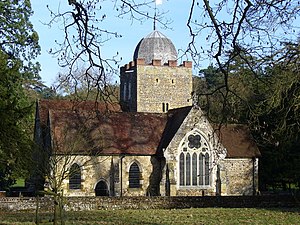
 
Saxon/Norman Aldbury 'neglected old church ....too much like a shameless unburied corpse.' Maybe he didn't like the 19th cupola that replaced a spire.
Now listed, restored , preserved and protected from all sides.
 
The Hog's Back near Guildford
 
 
Here is an extract from my novel:  Frost has been urging Edward to write poetry and use 'In Pursuit...' to demonstrate that his friend was a poet in the making:

'Robert read out sections concerning the Other Man who reappeared time and again during Edward’s journey from London to the Quantocks. Certainly there was something uncanny, an uneasiness, about the contingency, re-occurring over and over, which might make a poem. Robert’s own poetry, his ‘books of people’, could have accommodated such a character. But had Robert seen further, seen what the Other Man was?

No, Robert was turning on. He read a passage where Edward had almost despaired of finding a bed for the night on Easter day.

‘Listen:  “I found a bed and a place to sit and eat in, and to listen to the rain breaking over gutters and splashing on to stones, and pipes swallowing rain to the best of their ability, and signboards creaking in the wind; and to reflect on the imperfections of  inns and life¾

You see?’

Edward smiled – weather was a prevailing theme for him, like a descant accompanying his life. He remembered the rest of the chapter – his long discourse on clay pipes and the Other Man’s obsession with weather vanes. Unlikely that Robert would find much in them. No, he moved on, commenting on the passage on George Herbert at Bemington.

When he came to the chapter on Somerset he fell silent. Edward could hear the water murmuring below them under the bridge again.

‘What are you reading?’ Edward asked after a time.

‘I guess it’s everywhere, the poetry – just listen.’ He read in his leisurely way, breaking the lines as though he were reading blank verse.

‘I went out into the village at about half-past nine in the dark, quiet evening. A few stars penetrated the soft sky; a few lights shone on earth, from a distant farm seen through a gap in the cottages. Single and in groups, separated by gardens and bits of orchard, the cottages were vaguely discernible; here and there a yellow window square gave out a feeling of home, tranquillity, security. Nearly all were silent. Ordinary speech was not to be heard, but from one house came the sounds of a harmonium being played and a voice singing a hymn, both faintly. A dog barked far off. After an interval a gate fell-to lightly. Nobody was on the road.”

‘And again – these images …see:  The pollard willows fringing the green, which in the sunlight resemble mops, were now very much like a procession of men, strange primeval beings, pausing to meditate in the darkness.”

That’s great. The music and the drama in it, working together. And the way it ends:  I felt that I could walk on thus, sipping the evening silence and solitude, endlessly.” '
                                                    ...................................................................
No more from the novel in subsequent  IPS blogs - just Edward Thomas.

Saturday, February 27, 2016

Edward Thomas - the Birthday Walk, March 6th 2016
Yew Tree Cottage

Up the hangar

 
Starting at 10.30am  from Bedales School, Steep, Hampshire.
The walk traces Thomas's walks around Steep, the inspiration for much of his poetry.

Tuesday, January 26, 2016

'Adlestrop' and 'Tears' - more 'sprained ankle' poems following his accident running downhill.
Both written or at least begun on the 8th January 1915

We may think there is nothing new to say about Adlestrop, but Edna Longley's marvellous notes to her edition sees the intense juxtaposition of composition showing a development. Tears has history and ambiguity, reflecting the violence of hounds and soldiers as well as their beauty, and perhaps stirrings of conscience about the enlisting issue.

Adlestrop  - and perhaps that's why it's so easy to love - is an appreciation of England 'aesthetically' only, something about which, after the epiphany of the autumn before, Thomas was beginning to feel uncomfortable.

But how wonderful that he could use his memories and his field notebooks to create these works while sitting in a deck-chair in the living room with his leg propped up, taking up most of the room and no doubt grumbling at everything Helen was doing.
 
Tears
It seems I have no tears left.
They should have fallen---
Their ghosts, if tears have ghosts, did fall---that day
When twenty hounds streamed by me, not yet combed out
But still all equals in their rage of gladness
Upon the scent, made one, like a great dragon
In Blooming Meadow that bends towards the sun
And once bore hops: and on that other day
When I stepped out from the double-shadowed
Tower Into an April morning, stirring and sweet
And warm. Strange solitude was there and silence.
A mightier charm than any in the Tower
Possessed the courtyard. They were changing guard,
Soldiers in line, young English countrymen,
Fair-haired and ruddy, in white tunics.
Drums And fifes were playing 'The British Grenadiers'.
The men, the music piercing that solitude
And silence, told me truths I had not dreamed,
And have forgotten since their beauty passed.

Sunday, January 24, 2016

Edward Thomas' Beauty', another 'sprained ankle' poem.

This is my favourite Thomas poem. A miniature eighteen-line autobiography, an honest self-appraisal, a misery-memoir consciously and humorously undermined and upturned. A not-quite sonnet -currently fashionable - retaining the punch of the mood and tone change and letting it blossom. Those birds, always exact to their 'jizz'  but meaning much more:
'The birds may represent alternative ways of dealing with neurosis; a regressive resort to nostalgia, wailing for something lost; or progress towards the grounded selfhood phrased as 'home and love'.
 
BEAUTY

WHAT does it mean? Tired, angry, and ill at ease,
No man, woman, or child alive could please
Me now. And yet I almost dare to laugh
Because I sit and frame an epitaph-
'Here lies all that no one loved of him
And that loved no one.' Then in a trice that whim
Has wearied. But, though I am like a river
At fall of evening when it seems that never
Has the sun lighted it or warmed it, while
Cross breezes cut the surface to a file,
This heart, some fraction of me, hapily
Floats through a window even now to a tree
Down in the misting, dim-lit, quiet vale;
Not like a pewit that returns to wail
For something it has lost, but like a dove
That slants unanswering to its home and love.
There I find my rest, and through the dusk air
Flies what yet lives in me. Beauty is there


WHAT does it mean? Tired, angry, and ill at ease,
No man, woman, or child alive could please
Me now. And yet I almost dare to laugh
Because I sit and frame an epitaph-
'Here lies all that no one loved of him
And that loved no one.' Then in a trice that whim
Has wearied. But, though I am like a river
At fall of evening when it seems that never
Has the sun lighted it or warmed it, while
Cross breezes cut the surface to a file,
This heart, some fraction of me, hapily
Floats through a window even now to a tree
Down in the misting, dim-lit, quiet vale;
Not like a pewit that returns to wail
For something it has lost, but like a dove
That slants unanswering to its home and love.
There I find my rest, and through the dusk air
Flies what yet lives in me. Beauty is there


Wednesday, January 13, 2016


Edward Thomas in January 1915


The 'sprained ankle' poems.

Edward Thomas sprained his ankle at New Year 1915. Confined to bed or a chair, he wrote prolifically.
Two days after the accident Edward wrote The Source and two days after that, The Penny Whistle. Both were inspired by  visits to his friend Vivien Locke Ellis in East Grinstead,
From his notebook:
"3.30pm charcoal burner by blue hut piping slowly a bright old country tune and making it mellow and birdlike in the hollow deep valley."
________________________________________________
     The Penny Whistle
THE new moon hangs like an ivory bugle
In the naked frosty blue;
And the ghylls of the forest, already blackened
By Winter, are blackened anew.
The brooks that cut up and increase the forest,
As if they had never known
The sun, are roaring with black hollow voices
Betwixt rage and a moan.
But still the caravan-hut by the hollies
Like a kingfisher gleams between:
Round the mossed old hearths of the charcoal-burners
First primroses ask to be seen.
The charcoal-burners are black, but their linen
Blows white on the line;
And white the letter the girl is reading
Under that crescent fine;
And her brother who hides apart in a thicket,
Slowly and surely playing
On a whistle an olden nursery melody,
Says far more than I am saying.

From Fotolibrary

Friday, September 18, 2015

The White Horse, Prior's Dean, or The Pub With No Name.


This Saturday, 19th September 2015.


The Edward Thomas Fellowship has organised a tremendous event to celebrate the pub which was the setting for Edward Thomas's first poem.
The inn, as Thomas would have called it - is the  Pub-with-no-name near  Froxfield and Prior's Dean, but really near nowhere at all. It is  a comfortable walk from Steep and the subject of  his first known poem, Up in the Wind.(3rd December 1914).

The Pub with no name - the inn sign frame remains blank. ( Its name is The White Horse)


In November 1914  he drafted a piece in his exercise book about the inn and the 'wild girl' who worked there, "a daughter of the house, fresh from a long absence in service in London, a bright  active wildish slattern with a cockney accent and her hair half down."  He begins:


"Tall beeches overhang the inn, dwarfing and half hiding it, for it lies back a field’s breadth from the by road. The field is divided from the road by a hedge and only a path from one corner and a cart track from the other which meet under the beeches connect the inn with the road. But for a signboard or rather the post and empty iron frame of a signboard close to the road behind the hedge a traveller could not guess at an inn. The low dirty white building looks like a farmhouse, with a lean-to, a rick and a shed of black boarding at one side . . . "

As Edna Longley writes, "Up in the Wind is Thomas's closest approximation to the Robert Frost "eclogue" in which rural speakers tell or act out their story." Her annotation to the poem adds so much to the reading of it.

The event is open to the public, but the lunches, including the  'Edward Thomas sausage', are already booked. There is to be a strenuous walk beginning at 10 15 from the pub, lunch  and the dedication of a bench to Thomas. In the evening Pedal Folk and others are performing at Steep.

Here is the beginning of the  beginning of the poem, but not the version we know. It is an early draft from the Oxford digitalisation project, full of too much verbiage but giving an insight into the place and the process.  Don't ask me why, though on screen it is laid out with enjambments, when you copy and paste they are lost! The capital letters help you find your way and in this case I find it interesting - half note-book, half poem.

UP IN THE WIND by EDWARD THOMAS 'I could wring the old thing's neck that put it here! A public-house! it may be public for birds, Squirrels, and suchlike, ghosts of charcoal-burners And highwaymen.' The wild girl laughed. 'But I Hate it since I came back from Kennington. I gave up a good place.' Her Cockney accent Made her and the house seem wilder by calling up--- Only to be subdued at once by wildness--- The idea of London, there in that forest parlour, Low and small among the towering beeches, And the one bulging butt that's like a font. Her eyes flashed up; she shook her hair away From eyes and mouth, as if to shriek again; Then sighed back to her scrubbing. While I drank I might have mused of coaches and highwaymen, Charcoal-burners and life that loves the wild. For who now used these roads except myself, A market waggon every other Wednesday, A solitary tramp, some very fresh one Ignorant of these eleven houseless miles, A motorist from a distance slowing down To taste whatever luxury he can In having North Downs clear behind, South clear before, And being midway between two railway lines, Far out of sight or sound of them? There are Some houses---down the by-lanes; and a few Are visible---when their damsons are in bloom. But the land is wild, and there's a spirit of wildness Much older, crying when the stone-curlew yodels His sea and mountain cry, high up in Spring. He nests in fields where still the gorse is free as When all was open and common. Common 'tis named And calls itself, because the bracken and gorse Still hold the hedge where plough and scythe have chased them. Once on a time 'tis plain that the 'White Horse' Stood merely on the border of waste Where horse and cart picked its own course afresh. On all sides then, as now, paths ran to the inn; And now a farm-track takes you from a gate. Two roads cross, and not a house in sight Except the 'White Horse' in this clump of beeches. It hides from either road, a field's breadth back; And it's the trees you see, and not the house, Both near and far, when the clump's the highest thing And homely, too, upon a far horizon To one that knows there is an inn within.

Saturday, May 23, 2015

Edward Thomas's first student lodgings, Cowley Road, Oxford.

On Saturday May 16th the plaque commemorating Edward Thomas's first year in Oxford was declared 'Installed'. It's a really attractive  stone plaque:

Mason - Richard Morley


We had a ceremony in the garden of 113. Richard Emeny, Chairman of the Edward Fellowship, describing how Edward came here to study before winning a scholarship to Lincoln College to read history.  I read one of the many letters written to Helen - almost daily very loving letters - and Gwilym Scourfield read the poem, The Word.
 
Appropriately we moved on to Lincoln College with Stephen Gill, Professor Emeritus, conducting us, seeing what we believe were Edward's rooms on Staircase 12- but I have my doubts. The Hall at Lincoln is charming, intimate with dark panelling and the usual portraits of  old wardens and the famous - John Wesley being prominent.
Lincoln's lack of money meant that it did not get 'restored' ie spoiled, and the Chapel's window glass is a  ? 16th Century wonder.
 
Lincoln College Chapel

Jonah and the Whale.
 
 I think the poem reflects a common experience- we forget almost all we studied formally and come to know what will last and be essential to us.
 
The Word

 THERE are so many things I have forgot,
That once were much to me, or that were not,
All lost, as is a childless woman's child
And its child's children, in the undefiled
Abyss of what can never be again.
I have forgot, too, names of the mighty men
That fought and lost or won in the old wars,
Of kings and fiends and gods, and most of the stars.
Some things I have forgot that I forget.
But lesser things there are, remembered yet,
Than all the others. One name that I have not--
Though 'tis an empty thingless name--forgot
Never can die because Spring after Spring
Some thrushes learn to say it as they sing.
There is always one at midday saying it clear
And tart--the name, only the name I hear.
While perhaps I am thinking of the elder scent
That is like food, or while I am content
With the wild rose scent that is like memory,
This name suddenly is cried out to me
From somewhere in the bushes by a bird
Over and over again, a pure thrush word.